





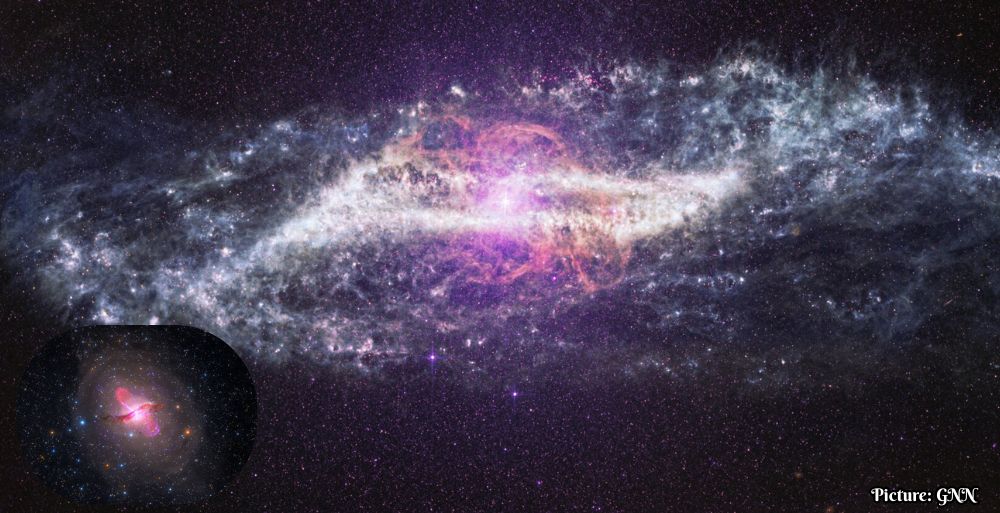
A recent study utilizing the James Webb Space Telescope has unveiled intricate details of Centaurus A, a galaxy shaped by a historic cosmic collision, enhancing understanding of galaxy evolution and black hole dynamics.
NASA’s James Webb Space Telescope (JWST) has released new images that provide unprecedented insights into the structure and dynamics of Centaurus A, a galaxy located approximately 11 million light-years from Earth. This unveiling, coinciding with the fourth anniversary of Webb’s science operations, underscores the telescope’s capabilities in revealing cosmic phenomena previously obscured by dust.
Centaurus A is unique among nearby galaxies due to its high level of activity, making it an essential subject for astronomers studying the interplay between galaxies and supermassive black holes. At the heart of Centaurus A lies a supermassive black hole that actively consumes surrounding material, generating powerful jets and significant energy output that influence the galaxy’s structure and star formation processes.
Historical Context and Cosmic Collision
Centaurus A’s unusual features can be traced back to a significant collision with another galaxy approximately two billion years ago. This merger has left a lasting impact on the galaxy’s morphology, contributing to its distinctive characteristics and ongoing star formation activities. Previous observations from the Hubble Space Telescope were unable to penetrate the dust clouds that shroud the galaxy’s core, while the retired Spitzer Space Telescope provided insights into larger-scale structures without identifying individual stars.
The JWST’s advanced sensitivity across near- and mid-infrared wavelengths allows astronomers to see through these dust lanes, revealing a complex tapestry of stars and gas. The new images showcase a densely packed field of individual stars, providing a clearer understanding of the timeline of events that have shaped the galaxy.
Insights from JWST Observations
According to Shawn Domagal-Goldman, the division director of Astrophysics at NASA Headquarters, the JWST represents a significant advancement in observational astronomy. He stated, “No single telescope tells the whole story. Discoveries build over time, and new observatories expand on the foundations laid by earlier missions. Webb represents the most powerful step forward yet, opening a window into wavelengths and details never before accessible.” This capability allows for more nuanced studies of cosmic structures.
The mid-infrared imaging capabilities of JWST have highlighted the rich dust structures in Centaurus A, which take on intricate shapes that both surprise and intrigue astronomers. Notably, a warped band resembling a parallelogram traverses the galaxy’s center, while wisps of material extend outward, resembling cosmic clouds. An “S” shaped feature captured in the JWST images raises questions regarding its formation and the influence of the supermassive black hole.
Many of the glowing red points in the JWST images correspond to dust-rich stars or stellar nurseries, where new stars are forming or older stars are shedding material back into space. This dust plays a crucial role in the galaxy’s life cycle, serving as the raw material for future generations of stars and planetary systems.
Galactic Archaeology and Black Hole Dynamics
The JWST’s high-resolution capabilities enable astronomers to conduct what can be described as galactic archaeology, examining Centaurus A star by star. The grainy appearance in the combined images from its Mid-Infrared Instrument (MIRI) and Near-Infrared Camera (NIRCam) is a result of the densely packed individual stars, each of which contributes to a comprehensive timeline of the galaxy’s evolution. This timeline includes key events such as the formation of older stars, periods of decreased activity, bursts of star formation triggered by the collision, and new stars formed from gas disturbed in the aftermath.
Furthermore, JWST’s spectroscopic analysis offers insights into the dynamics of gas movement within the galaxy. Early findings indicate the presence of fast-moving ionized gas flowing outward, likely propelled by the black hole’s activity. Additionally, warmer molecular hydrogen is detected in a warped rotating disk near the center of Centaurus A. Such observations are crucial for addressing one of the fundamental questions in astronomy: the influence of supermassive black holes on their host galaxies.
The relationship appears to be complex; while the black hole can compress gas and trigger star formation, it can also expel material, thereby limiting star formation. Centaurus A serves as a rare nearby laboratory for studying this cosmic interplay.
Conclusion
The James Webb Space Telescope continues to revolutionize our understanding of the universe, not only by probing distant worlds but also by investigating the intricate structures and origins of galaxies like Centaurus A. As the premier space science observatory, Webb is set to provide further insights into the mysteries of our cosmos, guided by its collaborative efforts with the European Space Agency (ESA) and the Canadian Space Agency (CSA).
For more information and high-resolution images, visit NASA’s official site.




No Comment! Be the first one.