





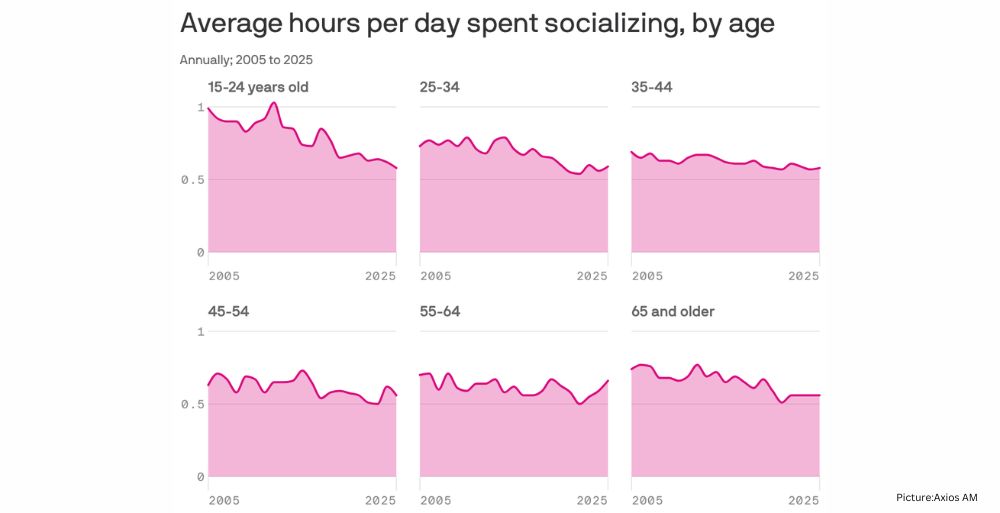
Americans now spend an average of just 35 minutes a day socializing, down from 45 minutes two decades ago, with young adults experiencing the steepest decline in face-to-face interaction.
Americans are spending significantly less time socializing than they did two decades ago, with younger generations experiencing the steepest decline, according to newly released findings from the American Time Use Survey conducted by the U.S. Bureau of Labor Statistics.
The survey found that average daily time spent socializing has dropped from 45 minutes to 35 minutes over the past 20 years, reflecting a broad shift in how Americans interact with one another.
The sharpest decline was recorded among 15- to 24-year-olds, whose average daily time spent socializing fell from about one hour per day to just 35 minutes.
Researchers and social scientists say the trend reflects a broader transformation in American social life, with implications extending beyond personal relationships to public health, civic engagement, and overall well-being.
Several factors have been identified as contributing to the decline.
One of the most significant is the widespread adoption of smartphones and social media. According to Gallup, teenagers now spend an average of 4.8 hours per day using apps such as TikTok, Instagram, and Snapchat, increasingly replacing in-person interaction with digital communication.
Experts also point to the lasting effects of the COVID-19 pandemic, which accelerated remote work and virtual lifestyles. Although pandemic restrictions have ended, many Americans continue to work from home, reducing opportunities for everyday social interaction.
Lifestyle changes have also made staying home more convenient. Larger homes, improved home entertainment systems, and the widespread availability of food delivery services have reduced the need for people to leave their homes for leisure or dining.
A 2025 study by researchers at the University of Colorado Boulder found that many traditional gathering places—including libraries, coffee shops, museums, and other public community spaces—have closed over the past decade, further limiting opportunities for face-to-face interaction.
The decline also coincides with the closure of religious institutions across the country, as churches continue to shut down at historically high rates, reducing another longstanding source of community engagement.
The findings add to growing evidence that social isolation has become a defining feature of modern American life, with researchers warning that declining in-person interaction could have lasting consequences for mental health, trust, civic participation, and longevity.






No Comment! Be the first one.