





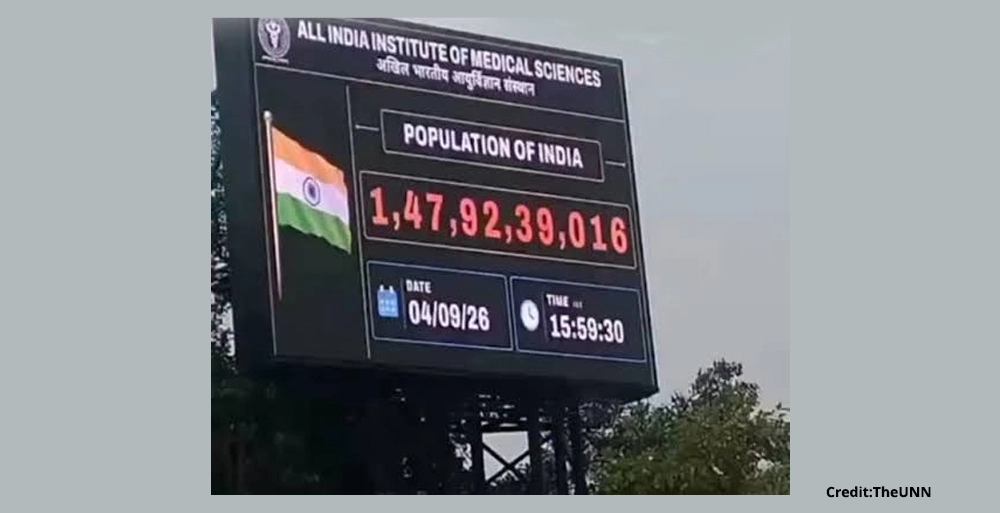
A digital billboard in Delhi has gone viral for showcasing India’s burgeoning population, which has surpassed 1.48 billion, raising critical questions about resource management and future challenges.
A large digital billboard positioned near the All India Institute of Medical Sciences (AIIMS) in South Delhi has recently captured significant attention online by displaying India’s escalating population figures. According to the billboard, the nation’s population has crossed the 1.48 billion mark, surpassing that of China, which has seen a decrease of approximately 3.39 million, now standing at 1.404 billion. This comparison has sparked discussions about demographic trends and their implications for both countries.
Footage circulating on social media illustrates the population number increasing every second, drawing parallels to live follower counts on platforms like YouTube. However, it is crucial to note that the display, while appearing to function like a real-time tracker, relies on demographic projections and statistical models rather than actual birth and death data.
Features of the Digital Display
The digital screen, labeled ‘Population Of India,’ showcases a rapidly changing numerical counter that seems to track the population dynamically. Recent videos have reported the figure at 1,48,16,00,000, inching closer to the anticipated 1.5 billion threshold. Despite the real-time semblance, the counter does not reflect immediate demographic changes. Instead, it utilizes estimates from the United Nations (UN) and statistical projections to generate its figures. This distinction has evoked a mix of amusement and concern among social media users.
Comments shared online reflect a range of perspectives regarding the implications of rapid population growth. One user remarked on the potential need for a one-child policy in India, while another humorously questioned the absence of a pollution counter on the billboard. A notable comment stated, “The AIIMS population chart is getting scary! The numbers keep rising, and it clearly shows how rapidly India’s population is growing. If this trend continues, the pressure on hospitals, education, jobs, and resources could become a serious challenge.”
There are also claims that the billboard is operated by the National Population Stabilisation Fund, which aims to highlight demographic trends and the increasing health burdens faced by facilities like AIIMS. The digital population clock had earlier attracted widespread attention in September 2026, when it appeared to show India’s population crossing the 1.47-billion mark.
Historical Perspective on Population Dynamics
This digital population clock first garnered widespread attention in September 2026, when it reportedly indicated that India’s population had surpassed 1.47 billion. This timing aligns with significant demographic milestones, as India officially became the most populous country in the world in 2023, overtaking China, according to estimates from the United Nations. In the decades leading up to this transition, India experienced rapid urbanization, economic growth, and significant changes in reproductive health policies, which collectively influenced demographic trends.
India’s population growth trajectory continues upward, despite declining fertility rates in various regions. Recent projections suggest that India may reach the 1.5 billion mark by 2028. However, the actual growth will depend on several factors, including fertility rates, mortality rates, and other demographic influences. For instance, the total fertility rate in India has fallen from 5.2 in 1990 to approximately 2.0 in 2021, with some states reporting even lower figures. This decline is largely attributed to increased access to education and family planning resources, particularly among women.
As India navigates this critical demographic transition, the implications of a growing population are increasingly prominent in public discourse. Concerns regarding the strain on healthcare, education, employment opportunities, and essential resources have intensified, prompting calls for strategic planning and resource management to ensure sustainable growth and development.
Implications for Policy and Society
The ongoing dialogue surrounding population growth in India reflects broader global concerns regarding demographic changes and their effects on societal structures. Experts warn that unchecked population growth could exacerbate existing challenges in healthcare and education systems, potentially leading to increased competition for jobs and resources. Policymakers are urged to develop balanced strategies that address the pressures of a growing population while promoting sustainable development.
In a global context, India’s experience provides valuable insights for other nations grappling with similar demographic dynamics. Countries facing population surges or declines can learn from India’s strategies and challenges in managing population-related issues. The discussions ignited by the billboard serve as a timely reminder of the importance of addressing demographic trends and their implications effectively.
As the billboard continues to capture the public’s imagination, it serves not only as a numerical display but also as a catalyst for broader conversations about the future of India’s population and the societal changes that must accompany it. The urgency for comprehensive policy responses to manage the implications of demographic shifts has never been more critical, as India stands at a pivotal moment in its demographic evolution.
Public Reactions and Future Prospects
The viral nature of this digital display has not only attracted attention but also fostered a variety of public reactions, ranging from concern to humor. Many social media users have engaged in discussions about potential solutions to the challenges posed by rapid population growth. Suggestions range from implementing stricter family planning policies to enhancing educational opportunities and healthcare access, particularly in rural areas.
Moreover, the government and various stakeholders are likely to focus on the implications of these demographic changes in upcoming policy discussions. With elections on the horizon and population issues at the forefront, addressing these concerns will be paramount for political leaders. The future of India’s population and its growth trajectory remains a critical topic, as it will shape the nation’s socio-economic landscape for decades to come.
In conclusion, as India approaches the significant milestone of 1.5 billion, the conversation surrounding its population dynamics continues to evolve. The digital billboard in Delhi serves as a striking reminder of the challenges and opportunities that lie ahead, prompting a national dialogue about sustainable growth and the need for innovative solutions to ensure a prosperous future for all citizens.






No Comment! Be the first one.