





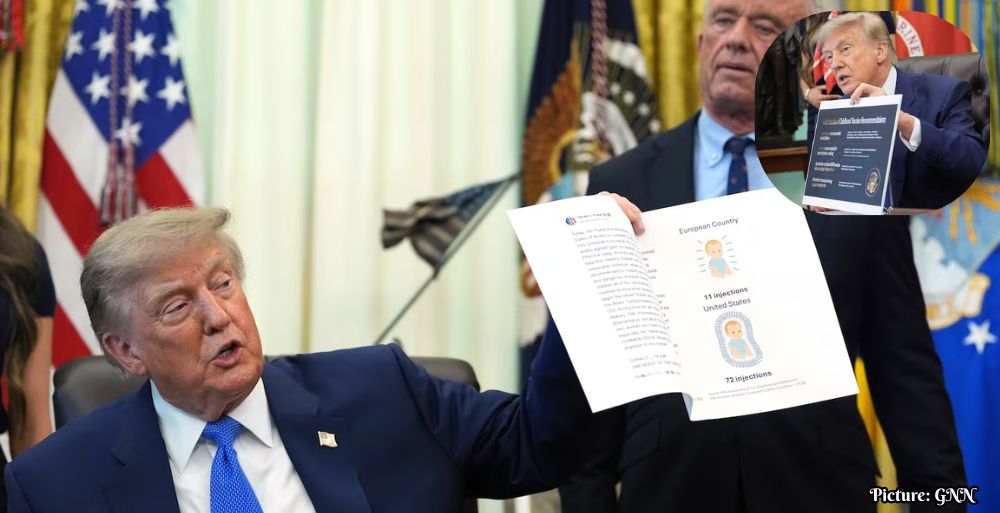
A new executive order from President Trump calls for changes to childhood vaccine schedules, aiming to separate the MMR vaccine into individual shots, while prompting concerns from health experts about the potential risks involved.
WASHINGTON (AP) — In a significant shift in public health policy, President Donald Trump signed an executive order on Monday that advocates for a revision of childhood vaccine recommendations. The order notably proposes that the measles, mumps, and rubella (MMR) vaccine be administered as three separate vaccinations rather than in a combined form, which has been standard practice in the United States.
The executive order also encourages the nation’s health department to enhance research on vaccines, despite extensive studies already existing on the subject, and to present a plan for offering individual vaccines for measles, mumps, and rubella—a service currently not available in the U.S.
This renewed emphasis on vaccines marks a departure from the Trump administration’s recent focus on less controversial health policies, such as promoting healthy eating and negotiating drug prices, particularly as the midterm elections approach.
Public Health Concerns
Public health experts have expressed serious concerns regarding the implications of Trump’s directive. They warn that spacing out vaccinations, as suggested by the president, could lead to an increased risk of children contracting vaccine-preventable diseases before they return for follow-up appointments. Vaccinations undergo rigorous testing and safety monitoring for years, reinforcing the established protocols for administering childhood vaccines.
During the announcement at the Oval Office, Trump characterized the order as a “major victory for parents’ rights, religious and constitutional rights, and for the gold standard science.” However, he also raised the controversial notion that the number or timing of vaccines could correlate with rising rates of autism spectrum disorder, despite a robust scientific consensus that has consistently found no link between vaccines and autism.
Responses from Health Professionals
Dr. Andrew Racine, president of the American Academy of Pediatrics, criticized the executive order, stating that it spreads “uncertainty, fear, and confusion where there doesn’t need to be any.” He reaffirmed that the established science regarding vaccines and their efficacy remains unchanged, emphasizing that the distribution of viruses and pathogens in the environment has not altered significantly. “Children in this country have not changed in the last 48 hours,” he noted.
In a swift rebuke, Senator Bill Cassidy, a Republican and chair of the Senate health committee, took to social media to denounce the executive order, asserting, “Vaccines are safe and do not cause autism. I’m a doctor. This executive order is wrong.”
Authority Over Vaccine Policy
Despite the order’s suggestions for revised vaccine recommendations, it is important to note that states, not the federal government, possess the authority to mandate vaccinations for schoolchildren. The executive order encourages states with existing school vaccine mandates to consider updating their laws in accordance with the administration’s proposed schedule.
The executive order follows a December directive from Trump to the Department of Health and Human Services (HHS) to review international vaccine recommendations and consider revisions to U.S. guidance. The department’s response involved reducing the number of vaccines recommended for children, a move that has since faced legal challenges and been blocked in court.
Typically, modifications to federal childhood vaccine recommendations require the approval of the director of the Centers for Disease Control and Prevention (CDC). The recently confirmed CDC director, Dr. Erica Schwartz, previously advocated for vaccination policies for military personnel in her former role with the U.S. Coast Guard. Lawrence Gostin, a public health law expert at Georgetown University, noted that the Supreme Court’s interpretation of presidential powers could allow Trump to override Schwartz if she does not agree with the new recommendations.
Previous Attempts and Legislative Context
Trump’s executive order is not the first of its kind; previous attempts to overhaul immunization guidance at HHS during his administration faced significant backlash. Health Secretary Robert F. Kennedy Jr., known for his anti-vaccine stance, dismissed an entire 17-member vaccine advisory committee within his first year and sought to implement more restrictive vaccination recommendations, which have also been halted by a federal judge. He has previously directed the CDC to abandon its assertion that vaccines do not cause autism, again without providing new evidence to substantiate such claims.
Throughout his presidency, Trump has maintained a focus on connecting autism rates to vaccines, increasing pressure on Kennedy to identify the cause of autism. In a Cabinet meeting last month, Trump inquired about the progress of autism research, emphasizing his interest in this contentious issue.
Current Vaccine Landscape and Implications
This executive order arrives during a time when students across the country are returning to classrooms amid concerns about a measles outbreak, which experts warn could jeopardize the United States’ measles elimination status. Additionally, federal data indicates a declining trend in kindergarten vaccination rates, with exemptions reaching an all-time high for the upcoming 2024-25 school year. Health professionals have voiced concerns that Trump’s rhetoric regarding vaccines could exacerbate vaccine hesitancy among parents.
As this situation evolves, the implications of the executive order and its potential impact on public health remain to be seen, with experts urging adherence to established scientific consensus on vaccination.






No Comment! Be the first one.