




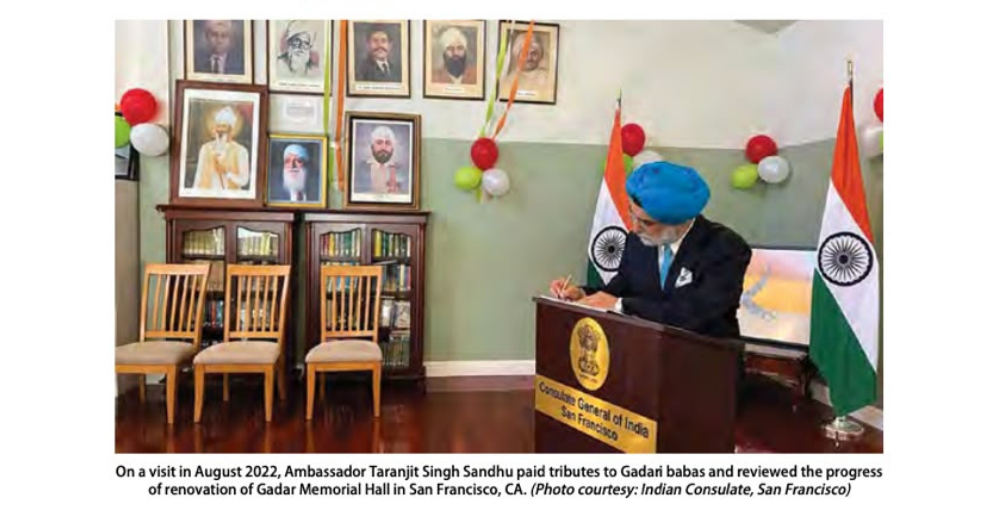
Waking up today in California, one senses the distinct characteristic of an American morning that no other civilization has quite managed to replicate. On the eve of its 250th birthday, the United States is gifted with a brightness that seems to arrive not merely from the sun but from the idea of the place itself, from the audacious conviction, encoded in its founding documents and renewed in every generation, that tomorrow can be made better by human intervention. On July 4, 2026, the nation will mark a quarter-millennium of continuous constitutional governance a record unmatched by any major power on earth. No account of America’s present ascendancy is complete without reckoning with one of its most quietly spectacular stories and the forgotten history of how America shaped India’s road to 1947 and Independence.
On Saturday, 1 November 1913, Har Dayal, a former Stanford University lecturer dressed in his worn, tattered coat, stood confidently in the middle of the mission-style hall of the newly opened Shattuck Hotel in Berkeley, California. This hotel, the finest in the city, was hosting a significant gathering: the entire top leadership of the Hindustan Association of the Pacific Coast (HAPC), led by Sohan Singh Bhakna, including Kartar Singh Sarabha and Gobind Behari Lal had gathered. The hall was packed. Alongside Indian farmers, students, laborers, and members of the HAPC, a group of American intellectuals supportive of India’s independence movement were present. Har Dayal’s network in North America was unmatched. His American friends, publisher Fremont Older, journalist John Barry, Professor Arthur Pope of Berkeley, social activist Charles Erskine Scott Wood, and even Stanford University’s President David Starr Jordan turned up for his event.
Despite facing health struggles in recent months, Har Dayal stood confidently. His sharp eyes scanned the crowd carefully, alert for any British Secret Service spies. Then he held the first issue of the Ghadr newspaper – a publication inspired by India’s First War of Independence in 1857, and delivered a fiery speech. He proclaimed, “A new era begins in the history of today’s India. The power of the ‘Pen’ will explode like a cannonball. This newspaper is the staunch enemy of the English Empire, and a bugle call for Indian youth. Awaken, take up arms, and fight for India’s independence.” The first issue of Ghadr, dated November 1st, 1913, described itself as “the enemy of the English Raj”. This radical weekly newspaper was intended to serve as both the prospectus and the voice of the movement. The name Ghadr, meaning ‘rebellion’ in Urdu, had been chosen by Har Dayal, and he explained, “Our name and work are identical.”
The idea of America itself carried symbolic weight for the Indian immigrants. The Declaration of Independence and the American Revolution provided an ideological vocabulary for Indian nationalists like Har Dayal who believed that a revolution would bring down Hukumat-i-Britannia through armed resistance. Soon the Ghadr ki Goonj (the sounds of rebellion) that had its headquarters on the soil of America reached worldwide with over 50,000 volunteers and the largest anti-colonial intercontinental movement in human history began. It came to be known as the Ghadr Party and demonstrated that America’s multicultural cities could serve as incubators for Indian revolutionary thought. American authorities largely tolerated the movement’s activities in deference to free speech norms, even as British colonial officials lobbied Washington to suppress it. This reluctance to simply do Britain’s bidding, gave Ghadr activists breathing room they would not have found elsewhere in the British-aligned world.
The progressive, ultra-liberal, non-sectarian, and gender-neutral, Ghadr Party launched in California, was the most significant development in the story of Indian resistance to colonial occupation since the formation of the Indian National Congress in 1885. On 13 April 1915, Mohandas Karamchand Gandhi (later Mahatma Gandhi) after earning fame as an activist in South Africa arrived at St. Stephen’s College in Delhi. Principal Sushil Kumar Rudra and Rev. Charles Andrews spoke about their former student Har Dayal’s remarkable initiatives towards India’s freedom, including non-cooperation, civil-disobedience and revolutionary activity. Earlier in 1909, Har Dayal’s exceptional oratory skills left British audiences in awe, inspiring a young student at Harrow – Jawaharlal Nehru. Remarkably the Ghadr movement, also the opening salvo in the Indian nationalist endeavor began a year before the world would be engulfed in ‘the Great War’ (World War 1) and four years before the Russian Revolution. Ahead of its time, it was eight years before the Communist Party of India’s Hasrat Mohani and Swami Kumaranand, moved a resolution for complete independence. The Congress Party adopted its famous slogan for ‘poorna swaraj’ only in December 1929 at its Lahore session – sixteen years after the Ghadr Party first raised its demand for independence.
Ghadr lit the spark that inspired the revolutionaries in India with ships dispatched from America with arms and ammunition. An alarmed Hukumat-i-Britannia set out to crush Ghadr. Fearing the worst, they banned Har Dayal from India, distanced him from his family, and painted him out of the Indian newspapers. Almost 200 British secret agents, including Somerset Maugham, were dispatched with a licence to kill the globe-tottering Har Dayal, and this led to the creation of MI6. A contingent of British spies arrived in America and Canada to infiltrate the movement. But it was too late. Always ahead of his tormentors, Har Dayal escaped to Europe to covertly guide Ghadr from the continent. The Hukumat-i-Britannia could never frame charges against him.
Next, Lala Lajpat Rai, one of the most fiery voices for Indian independence, arrived in America during World War 1 and helped found the India Home Rule League of America in New York in 1917, to build American public sympathy for Indian independence. These early diaspora efforts planted seeds that would later bloom into meaningful political pressure. Figures like William Shirer and Reinhold Niebuhr wrote sympathetically about Mahatma Gandhi’s campaigns, helping shape American public opinion. Pearl Buck, the Nobel Prize-winning author, used her public platform to argue that American support for colonialism was self-defeating. Jag Jit Singh, president of the India League of America, became one of the most effective lobbyists for Indian independence in Washington. He cultivated relationships with American Congressmen, organized speaking tours, and ensured that Indian voices reached American ears beyond the diplomatic sphere.
The most significant American intervention came during World War II, and its chief architect was President Franklin D. Roosevelt. FDR harbored a genuine, antipathy toward European colonialism. Roosevelt sent his personal envoy, Colonel Louis Johnson, to India to assess the political situation. He believed that the war against fascism could not be morally coherent if Britain simultaneously maintained empires. In private conversations and state communications, Roosevelt repeatedly pressed British Prime Minister Winston Churchill on the question of Indian independence. Roosevelt pressured Churchill to make meaningful concessions to the Congress Party, writing him a blunt personal letter warning that the failure of the Cripps Mission was a serious political blunder.
By then Har Dayal had passed away on a cold winter night in Philadelphia on March 4, 1939, while on a lecture tour in America, leaving behind a trailblazer’s mark on the world. It’s not surprising that fictional characters with a likeness to Har Dayal appeared in major novels, and Paramount Pictures produced a Hollywood film based on his life in 1922, cementing his place in history. He did not live to see India’s freedom, however elements of the Ghadr Party merged with Subhas Chandra Bose’s Azad Hind Fauj. Finally, largely due to the efforts of Azad Hind Fauj, countless revolutionaries and the freedom fighters of the Congress Party, India won its freedom on August 15, 1947. The United States was among the first nations to formally recognize independent India, and the Indian government received warm congratulations from Washington. The story of American involvement in Indian independence is ultimately a story about how ideas, interests, and international pressure intersect with the will of a people determined to be free.




No Comment! Be the first one.