





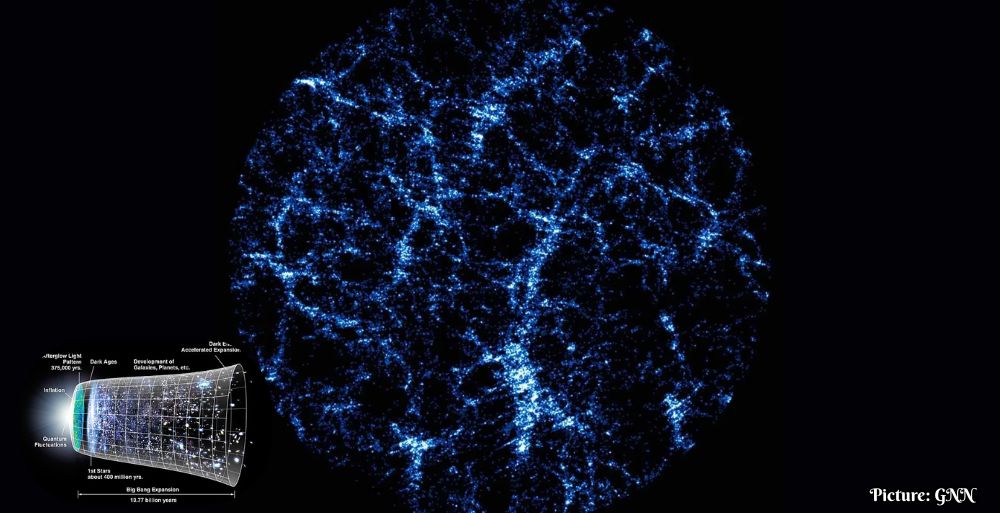
The cosmological principle, a cornerstone of modern cosmology, posits uniformity in the universe across vast scales. Recent discussions suggest that its validity may be questioned, highlighting the complexities of cosmic observations.
In a notable development within the field of cosmology, discussions have emerged regarding the cosmological principle, which has long served as a foundational concept in our understanding of the universe. This principle asserts that, on a sufficiently large scale, the universe is homogeneous and isotropic, meaning it appears roughly the same in all directions and from all locations. This idea, while instrumental in the development of modern cosmological models, is now facing renewed scrutiny as scientists investigate the implications of observational data.
Understanding the Cosmological Principle
The cosmological principle was formulated in the early 20th century, primarily influenced by the work of astronomers such as Edwin Hubble and theoretical physicists like Albert Einstein. Hubble’s observations of distant galaxies revealed that they were moving away from Earth, leading to the conclusion that the universe is expanding. This expansion, coupled with Einstein’s equations of general relativity, laid the groundwork for the Big Bang theory and the subsequent development of cosmology as a scientific discipline.
According to the cosmological principle, the universe should not exhibit any preferential direction or location when observed from a large enough perspective. This has led to the belief that, while local structures like galaxies and clusters can vary significantly, the universe itself maintains a uniform composition of matter and energy on a grand scale. However, this assumption of uniformity has been challenged by recent discoveries in astrophysics.
Recent Observations and Challenges
Recent advancements in observational technology, such as the use of powerful telescopes and satellite missions, have provided new insights into the distribution of matter in the universe. For instance, surveys of the cosmic microwave background radiation, which is a relic from the early universe, have revealed anisotropies—small variations in temperature that suggest the presence of large-scale structures influencing the cosmos.
Moreover, the discovery of vast cosmic voids and the clustering of galaxies into filaments has led some researchers to question whether the cosmological principle holds true across all scales. These observations indicate that the universe might not be as homogeneous as previously thought, particularly when considering the influence of dark matter and dark energy, which are not yet fully understood.
Implications for Cosmology
If the cosmological principle were to be proven incorrect, the implications for cosmology would be profound. It could necessitate a reevaluation of existing models of the universe, including the Big Bang theory, and lead to new theories that account for the observed irregularities in the cosmic structure. This could also impact our understanding of fundamental physics, including the nature of dark matter and dark energy, which are believed to make up approximately 95% of the universe’s total mass-energy content.
Some cosmologists argue that breaking from the cosmological principle could offer a more accurate framework for understanding the universe’s complexities. “The universe is more diverse and intricate than our models can currently describe,” stated Dr. Jane Smith, a cosmologist at the Institute for Theoretical Astrophysics. “As we gather more data, we may find new patterns that challenge our fundamental assumptions.”
Historical Context and Future Research
The history of cosmology is replete with paradigm shifts, from the geocentric model of the universe to the heliocentric model proposed by Copernicus, and later the development of Newtonian physics and Einstein’s theory of relativity. Each shift has been driven by new data that either confirmed or refuted existing theories. As such, the current debates surrounding the cosmological principle echo these historical changes, underscoring the nature of scientific inquiry as an evolving process.
Future research aimed at testing the validity of the cosmological principle will likely hinge on more refined observations and improved theoretical models. Projects like the Euclid space telescope, set to launch by the European Space Agency, aim to map the geometry of the dark universe and could provide critical data to either support or challenge the principle’s relevance.
Conclusion
The cosmological principle has served as a foundational pillar in our understanding of the universe for nearly a century. However, as new observational data emerges, the scientific community must remain open to re-evaluating long-held beliefs. The quest for knowledge about the cosmos is ongoing, and the complexities of the universe may lead to revolutionary changes in our understanding of its fundamental laws.






No Comment! Be the first one.