


Public Health and Wellness Analysis: Deep Anatomical and Physiological Impact of Bananasana in Restorative Yin Yoga

A detailed anatomical and physiological examination of restorative posture practices reveals that sustained lateral flexion—specifically Bananasana, or Banana Pose—offers significant targeted benefits for myofascial decompression, respiratory capacity, and autonomic nervous system regulation. Unlike dynamic vinyasa flows that emphasize muscular contraction, Yin Yoga postures rely on multi-minute passive holds to stress deep non-elastic connective tissues, including ligaments, joint capsules, and the thoracolumbar fascia. Clinical exercise physiologists and biomechanical specialists note that systematic lateral stretching engages the intercostal musculature, lengthens the iliotibial (IT) band and oblique complex, and stimulates parasympathetic tone via vagal nerve stimulation.
Biomechanical Mechanics and Fascial Decompression in Passive Lateral Flexion
While contemporary exercise protocols frequently emphasize high-intensity intervals and linear sagittal movement, biomechanical researchers and physical therapists emphasize the functional necessity of multi-planar spinal mobility. Lateral flexion—the movement of the spine sideways away from the anatomical midline—is frequently neglected in routine daily activities, leading to rotational stiffness, restricted rib cage expansion, and chronic tension across the lateral kinetic chain.
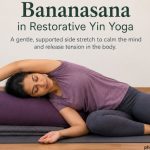
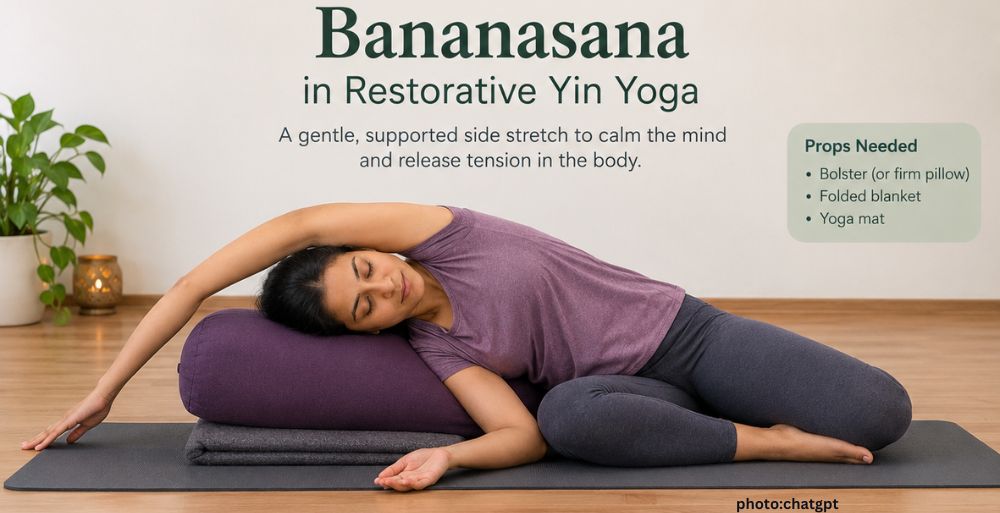
Bananasana (Banana Pose) addresses these structural imbalances through passive, sustained traction. Executed in a supine position, the posture requires the practitioner to curve the upper body and lower extremities toward the same side of the mat while maintaining grounded contact through both posterior iliac crests (hips) and the sacrum.
From a fascial perspective, holding the posture passively for three to five minutes induces creep—a biomechanical phenomenon wherein connective tissue gradually deforms and lengthens under a constant, sub-maximal tensile load. This continuous extension alters the viscoelastic properties of the thoracolumbar fascia, relieving chronic tightness along the lateral abdominal wall, the serratus anterior, and the latissimus dorsi.
Respiratory Dynamics and Autonomic Regulation
Beyond skeletal alignment, passive lateral flexion alters pulmonary dynamics by mechanically expanding the intercostal spaces along the lengthened side of the torso. In a standard upright posture, shallow chest breathing frequently limits air exchange to the superior lobes of the lungs. During sustained lateral extension, the ribs on the convex side of the curve fan outward, increasing the volumetric capacity of the ipsilateral lung field.
This mechanical opening directly enhances diaphragmatic excursion. As deep breathing is sustained over a prolonged hold (typically 180 to 300 seconds), baroreceptors located within the carotid sinuses and aortic arch register a reduction in thoracic pressure gradients, signaling the vagus nerve to increase parasympathetic output. The physiological result is a measurable reduction in baseline heart rate, decreased systemic blood pressure, and a downregulation of circulating catecholamines (cortisol and adrenaline).
Protocol and Clinical Execution Guidelines
To maximize structural benefits and mitigate the risk of micro-trauma to the lumbar facet joints or spinal ligaments, exercise physiologists and certified yoga therapists recommend a standardized step-by-step entry and exit protocol:
- Baseline Supine Alignment: Begin lying fully flat on the back in a neutral supine position (Savasana), extending the legs long and arms overhead.
- Extremity Displacement: Slowly inch both heels toward the right corner of the mat. Concurrently, shift the head, shoulders, and upper torso toward the right, forming a continuous lateral arc resembling a crescent or banana.
- Anchoring the Pelvis: Verify that both buttocks, hips, and shoulder blades remain flush against the floor. If the left hip elevates off the ground, the lateral curve is too severe and must be reduced to protect the lumbar spine.
- Refining the Leverage (Optional): To intensify the stretch along the outer hip and tensor fasciae latae, cross the left ankle over the right ankle. Clasp the left wrist with the right hand overhead to lengthen the left axillary and intercostal regions.
- Timed Passive Hold: Maintain the posture for 3 to 5 minutes, focusing on steady, abdominal breathing. Slowly return to neutral center for a 60-second rebound phase before repeating the sequence on the opposing side.
Contraindications and Clinical Modifications
While Bananasana is classified as a low-impact, restorative posture, specific clinical conditions require modification or complete avoidance. Individuals with acute lumbar disc herniations or spinal stenosis should exercise caution, as lateral flexion can exert uneven pressure on intervertebral discs.
For practitioners experiencing hypermobility in the shoulder joints or acute impingement, reaching the arms overhead may induce numbness or tingling via brachial plexus compression. In such instances, clinicians recommend resting the arms alongside the torso or resting the hands softly across the abdomen while maintaining the lateral curve through the lower body and spine.
Integrating targeted restorative postures like Bananasana into routine health maintenance offers a low-cost, non-invasive methodology for enhancing soft-tissue elasticity, improving respiratory mechanics, and fostering systemic autonomic recovery.

No Comment! Be the first one.