





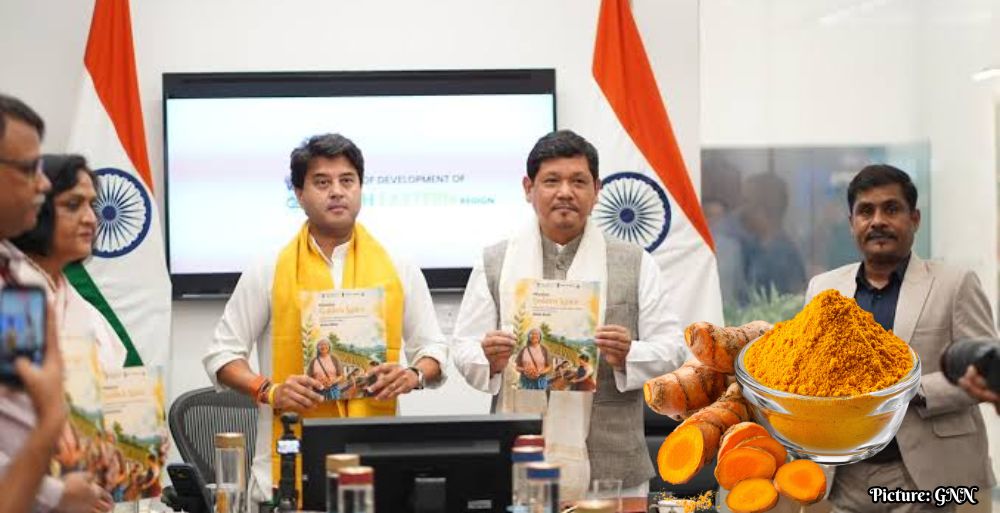
The Indian government has launched Mission Golden Spice, a ₹175.45 crore initiative to enhance the production and marketing of Meghalaya’s GI-tagged Lakadong turmeric, aimed at boosting farmers’ incomes and establishing the region as a global leader in high-curcumin turmeric.
The Government of India launched Mission Golden Spice on Tuesday, a comprehensive ₹175.45 crore initiative designed to transform Meghalaya’s GI-tagged Lakadong turmeric into a globally recognized premium spice. The mission aims to strengthen the entire value chain associated with turmeric production while enhancing the incomes of local farmers. This initiative was introduced by Union Minister for Communications and Development of North Eastern Region Jyotiraditya M. Scindia alongside Meghalaya Chief Minister Conrad K. Sangma.
Mission Golden Spice is a five-year program set to run from 2025 to 2030, structured in two distinct phases: the initial phase focuses on strengthening the value chain, followed by an expansion and scale-up phase. The mission is spearheaded by the Ministry of Development of North Eastern Region (MDoNER) and engages multiple central ministries and agencies, including the Ministries of Agriculture and Farmers’ Welfare, Food Processing Industries, and Commerce, among others. The collaborative effort aims to establish an integrated ecosystem for turmeric cultivation, processing, and marketing.
Context and Objectives of Mission Golden Spice
Scindia characterized Mission Golden Spice as a reflection of Prime Minister Narendra Modi’s vision for an “Atmanirbhar North East,” which translates to an economically self-sufficient northeastern region. He emphasized that the mission is part of the broader “Ashtalakshmi” development strategy, which aims to harness regional strengths by promoting unique products from each of the eight northeastern states. Lakadong turmeric has been identified as Meghalaya’s flagship product, owing to its high curcumin content, which ranges between 7–10 percent, nearly four times the global average. This positions Lakadong turmeric among the finest varieties available globally, with considerable potential in both nutraceutical and export markets.
The mission aims to significantly increase farmers’ earnings, targeting a rise from the current ₹30–40 per kilogram to approximately ₹80 per kilogram by 2030. Additionally, Scindia noted plans to expand the cultivation area of Lakadong turmeric from 2,500 hectares to an ambitious 7,500 hectares over the same period.
Global Recognition and Future Aspirations
Scindia also recalled that Lakadong turmeric was showcased by Prime Minister Modi at the recent G7 Summit, sparking international interest among global leaders. He urged stakeholders to prioritize the quality, authenticity, and sustainability of the product to ensure its competitive positioning in international markets.
Chief Minister Sangma reiterated that the mission builds upon years of groundwork laid by the state government, local officials, and farmers. He viewed the initiative as reflective of the Union Government’s proactive approach to identifying unique products from each northeastern state and constructing a comprehensive development model around them.
Furthermore, Sangma pointed out that attempts to cultivate Lakadong turmeric outside of Meghalaya have historically resulted in lower curcumin content, highlighting the unique agro-climatic conditions of the state that contribute to the turmeric’s superior quality. He expressed optimism that this developmental model could later be adapted for other Meghalaya products, including pineapple, ginger, jackfruit, honey, and mushrooms.
Addressing Structural Challenges
During the launch, MDoNER Secretary Nivedita Shukla Verma discussed the challenges faced by small farmers, who, despite the high quality and market potential of Lakadong turmeric, have struggled to achieve better incomes. She identified inadequate processing facilities, weak market linkages, limited value addition, and insufficient branding as key obstacles. The mission aims to tackle these structural issues by developing modern processing infrastructure, improving cold chain facilities, and creating stronger domestic and export market linkages.
The launch event also featured a film screening about the mission, interactions with progressive turmeric farmers from Meghalaya, and discussions with industry representatives and investors. Meghalaya’s Agriculture and Farmers’ Welfare Minister Timothy D. Shira highlighted that Lakadong turmeric symbolizes the state’s indigenous knowledge and agricultural heritage. He emphasized that the mission would establish the Northeast’s largest integrated organic turmeric processing and curcumin extraction facility, with a focus on empowering women, who play a crucial role in turmeric cultivation and processing.
Farmers from East and West Jaintia Hills expressed their enthusiasm for the initiative, stating it would help elevate Lakadong turmeric from a raw agricultural commodity to a premium branded product, generating new income opportunities through processing, value-added products, and expanded market access.
MDoNER anticipates that Mission Golden Spice will position Meghalaya’s GI-tagged Lakadong turmeric as a flagship “Brand North East” product on the global stage, fostering a sustainable and integrated value chain that benefits thousands of farmers across the state.





No Comment! Be the first one.