





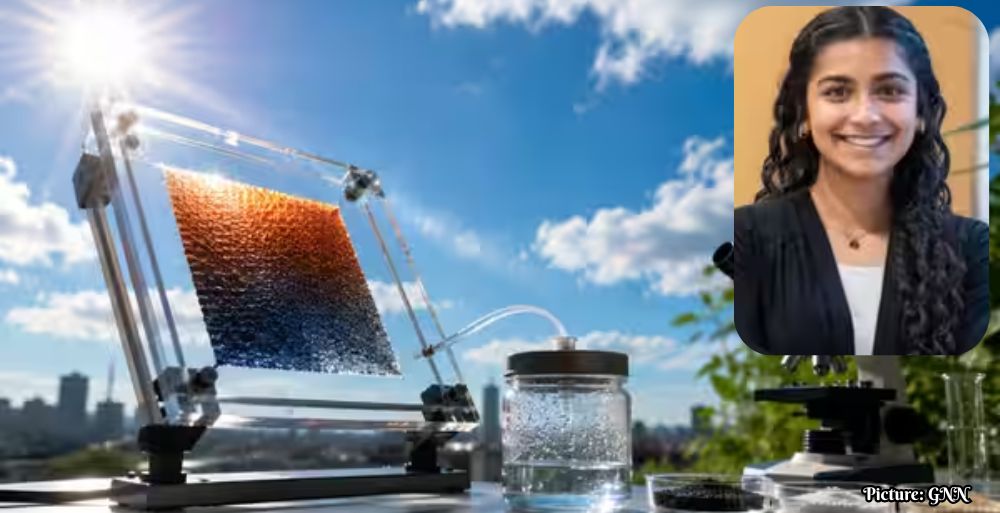
A high school junior from Niles, Illinois, Zainab Nathani, has developed an innovative material capable of extracting drinkable water from humid air using solar energy, a project that earned her recognition at a prominent science fair and underscores her commitment to global water access.
Niles, Illinois – Zainab Nathani, a junior at Niles Township West High School, has made significant contributions to the field of water harvesting technology with her creation of a material that extracts potable water directly from the atmosphere. This innovative approach relies solely on solar energy, positioning it as a promising solution for communities facing water scarcity. Nathani’s project, which utilizes emulsion-templated composite biogels, was awarded a Fourth Award in the Materials Science category at the 76th Annual Regeneron International Science and Engineering Fair (ISEF), held in Phoenix, Arizona, in May 2026. Her achievement follows her qualification through the Illinois Junior Academy of Science State Exposition.
Nathani’s work is rooted in her extensive research into water purification and atmospheric water harvesting technologies, driven by a long-standing commitment to ensuring clean water access for all. This project not only highlights her technical expertise but also reflects her dedication to advocating for global water equity.
Innovative Water Harvesting Technology
The core of Nathani’s innovation lies in the creation of a material that captures moisture from the air and releases it as liquid water when exposed to sunlight. This process operates without the need for electricity or additional energy inputs, making it particularly valuable for regions lacking reliable water sources. According to her LinkedIn profile, Nathani developed this project in collaboration with senior researchers at the Midwest Desalination Research Institute, where she focused on the creation of low-cost nanomaterials for atmospheric water harvesting.
Unlike conventional water extraction methods such as desalination or traditional filtration, Nathani’s biogels utilize their internal pore structure to absorb moisture even in relatively dry environments. This development presents a viable alternative for water-scarce regions, where traditional methods may be impractical or too costly. Her technology employs a technique known as emulsion templating, which involves mixing two normally immiscible liquids to create a porous gel structure from bio-based materials. This precise manipulation allows for the fine-tuning of the material’s pore architecture, optimizing its capacity for moisture absorption before being warmed by sunlight to release water.
Recognition and Future Goals
The recognition of Nathani’s project at the ISEF underscores its potential for real-world applications. The term “scalable” in her project title indicates her intention to develop the technology for future manufacturing and deployment, moving beyond mere laboratory demonstrations. This aligns with a broader international effort among scientists to transition atmospheric water generation from specialized research environments to affordable, everyday devices that can be utilized in arid or water-stressed areas.
“My goal is to create technology that not only serves as a proof of concept but can actually be adapted for widespread use in communities facing water shortages,” Nathani articulated during her project presentation at ISEF. This forward-thinking perspective is particularly relevant given the increasing global water crisis exacerbated by climate change and population growth.
Civic Engagement and Clean Water Advocacy
Nathani’s commitment to clean water extends far beyond her scientific endeavors. She has actively led local initiatives aimed at raising awareness and support for clean water access, demonstrating her belief that technological innovation must be paired with civic engagement to achieve meaningful change. She aspires to become a Water Challenge Ambassador, a role dedicated to empowering communities with knowledge and encouraging youth involvement in addressing global water issues.
Through the Niles Area Thirst Project, an initiative she founded in affiliation with the international Thirst Project, Nathani has successfully raised funds to construct wells in regions that lack reliable access to clean water. This initiative underscores her understanding that access to clean water is not merely a technical challenge but also a social justice issue that requires sustained advocacy and community involvement.
In addition, she serves as President of her school’s Futures in STEM Club and is an active three-season varsity athlete, exemplifying her ability to balance academic, athletic, and leadership responsibilities. This multifaceted engagement illustrates her commitment to fostering a culture of science, technology, engineering, and mathematics (STEM) among her peers while addressing pressing global challenges.
Educational Impact and Community Engagement
Alongside her innovative research and advocacy work, Nathani is also dedicated to education and mentorship. She tutors younger students in a variety of subjects, including mathematics, science, history, and language arts, thereby helping to inspire the next generation of learners and innovators. Her educational outreach reflects a holistic approach to science and community service, where technical innovation and civic responsibility go hand in hand.
As she continues her studies at Niles Township West High School, Nathani’s profile suggests a trajectory that bridges scientific discovery with impactful community outreach. By integrating her technical skills with her advocacy efforts, she exemplifies how young innovators can contribute to addressing complex global issues such as water scarcity. Her work demonstrates that the intersection of science and civic engagement can lead to tangible improvements in the lives of people affected by water shortages worldwide.
In conclusion, Zainab Nathani’s achievements serve as an inspiring example of how young individuals can harness their scientific talents and personal passions to address critical global challenges. As she continues to advance her research and advocacy efforts, her story highlights the importance of fostering the next generation of leaders committed to ensuring equitable access to clean water for all.





No Comment! Be the first one.