





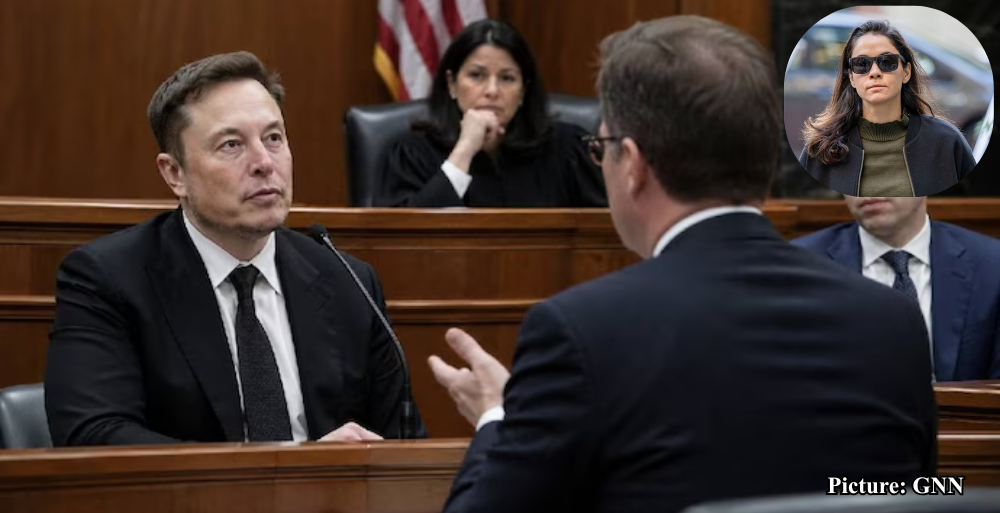
A former OpenAI board member detailed her personal relationship with Elon Musk during a federal court appearance, shedding light on the evolution of their connection and its implications for the tech industry.
OAKLAND, California – In a federal courtroom on Wednesday, Shivon Zilis, a former board member of OpenAI, provided extensive testimony about her personal and professional relationship with Elon Musk during a trial concerning Musk’s efforts to reverse OpenAI’s transition to a for-profit model. Zilis, who has worked as a venture capitalist and held executive roles in several of Musk’s companies, including Tesla and Neuralink, revealed significant details about her involvement with Musk and their shared family life.
Zilis testified that her relationship with Musk led to the birth of four children together, a fact that has drawn considerable attention amid the ongoing legal proceedings. During her testimony, Zilis recounted that Musk had offered to donate sperm in 2020, stating, “I still really wanted to be a mum and Elon made the offer around that time and I accepted.” This revelation highlights the unconventional nature of their relationship, which Zilis described as a “one-off” romance from about a decade ago. She emphasized that they were not romantically involved at the time of the sperm donation offer.
Background on OpenAI’s Transition
The trial centers around Musk’s legal challenge against OpenAI’s decision to change its corporate structure to a for-profit entity. This shift, which was discussed as early as 2017, was deemed necessary by OpenAI’s leadership to secure significant funding from investors. Court documents revealed that Musk had been an advocate for more control over OpenAI, expressing interest in increasing his influence within the organization.
During her testimony, Zilis explained that the initial arrangement regarding their children’s upbringing was to keep Musk’s paternity confidential. She stated, “We had agreed to keep his paternity strictly confidential,” indicating that her decision to inform OpenAI CEO Sam Altman about Musk’s role as the father of her twins was precipitated by an impending report from Business Insider.
Despite the complexities of their arrangement, Zilis noted that Musk has become an active participant in the lives of their children, spending several hours each week together as a family. This development stands in contrast to their original understanding, which did not foresee Musk taking on a significant paternal role.
Legal Implications and Corporate Governance
Zilis’s departure from the OpenAI board in March 2023 coincided with Musk’s launch of xAI, an AI firm that directly competes with OpenAI’s ChatGPT. The legal proceedings have spotlighted the interactions between Zilis, Altman, and OpenAI’s president Greg Brockman, especially regarding their discussions about the company’s future and potential restructuring.
Emails and text messages presented in court have illustrated the tensions surrounding Musk’s desire for greater control and the board’s resistance to his influence. Zilis noted in her correspondence that Musk’s suggestion to transition OpenAI into a B Corporation, a type of for-profit entity with specific mission-driven accountability, was aimed at addressing funding challenges. However, the leadership at OpenAI remained adamant that Musk should not have control over the company’s operations.
In response to inquiries about Zilis’s ongoing involvement with OpenAI despite Musk’s departure, Brockman stated, “We trusted her to keep the Elon conflict under control,” emphasizing the board’s confidence in Zilis’s ability to navigate the complexities of her relationship with Musk while fulfilling her responsibilities.
Implications for the Tech Industry
The trial has garnered significant attention, not only for its implications for OpenAI’s future but also for the broader impact on the tech industry’s governance and ethical considerations in personal relationships among executives. As the proceedings continue, the intersection of personal and professional dynamics within Silicon Valley remains under scrutiny.
OpenAI has faced scrutiny in recent years as it shifted from its original nonprofit mission to a for-profit model, a move that raised eyebrows among industry observers. The transition was partly driven by the need to secure substantial investments, which are crucial for advancing AI technology. Musk’s involvement in these discussions, coupled with his close relationship with Zilis, adds layers of complexity to the narrative surrounding OpenAI’s evolution.
As the trial progresses, the implications for corporate governance will be closely monitored. The legal arguments revolve not only around the decisions made by OpenAI’s board but also the ethical considerations tied to personal relationships within corporate structures. Zilis’s unique position as both a former board member and a close associate of Musk places her testimony at the heart of these discussions.
The trial highlights the challenges faced by tech companies as they navigate the balance between innovation, ethical governance, and personal relationships. Given the rapid evolution of AI technology and the competitive landscape, how OpenAI resolves these issues may set precedents for the industry at large.
As the proceedings unfold, experts predict that the case will prompt a broader discussion about transparency in corporate governance and the potential ramifications of personal ties among executives on decision-making processes.



No Comment! Be the first one.