





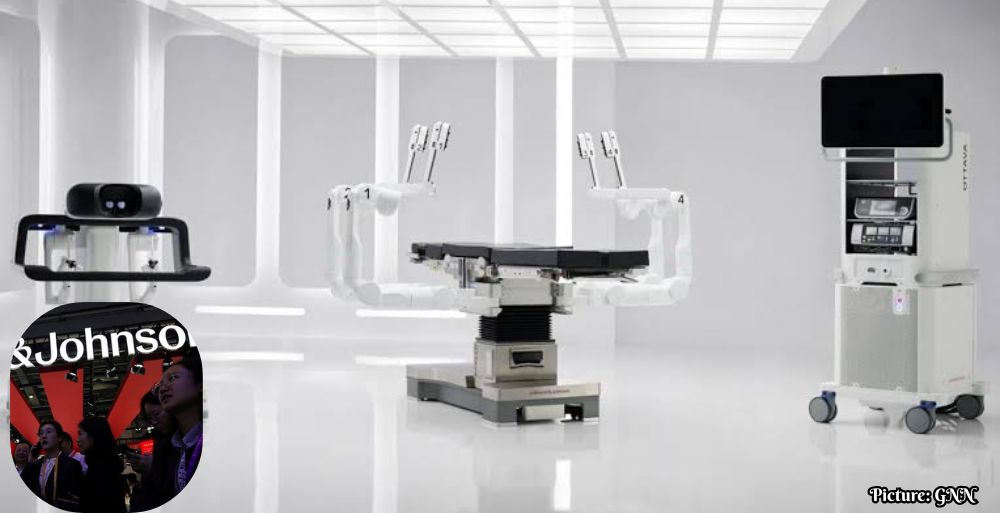
The U.S. Food and Drug Administration has granted De Novo marketing authorization for Johnson & Johnson’s Ottava robotic surgical system, clearing the global healthcare giant to enter the rapidly expanding soft-tissue surgical market. Featuring a novel table-integrated architecture that reduces operating room footprint by up to 50%, Ottava represents the second major heavyweight challenge to Intuitive Surgical’s long-standing dominance in robotic-assisted care following Medtronic’s entry. As hospitals weigh capital investments against high institutional switching costs, J&J’s entry signals a competitive shift in medical technology, with implications for clinical workflows, healthcare economics, and surgical training standardizations worldwide.
Federal Approval and Table-Integrated System Architecture
NEW BRUNSWICK, N.J. — Federal regulators have formally cleared Johnson & Johnson to commercialize its soft-tissue robotic surgical platform in the United States, granting De Novo marketing authorization for the company’s long-awaited Ottava system, according to regulatory filings and corporate disclosures released on Wednesday.
The regulatory clearance from the U.S. Food and Drug Administration (FDA) authorizes the multi-arm robotic platform for an array of general surgical procedures within the upper abdomen. Initial approved indications encompass common gastrointestinal and abdominal interventions, including Roux-en-Y gastric bypass, gastrectomy, gallbladder removal (cholecystectomy), gastric sleeve surgery, splenectomy, small bowel resection, appendectomy, fundoplication, hiatal hernia repair, and the removal of scar tissue through lysis of adhesions.
Unlike traditional soft-tissue surgical robots, which typically rely on bulky cart- or boom-mounted structures positioned alongside the patient, Ottava integrates four robotic arms directly into the operating room table itself. Engineering specifications provided by the company indicate that this structural integration reduces the physical footprint of the equipment by 30% to 50% compared to conventional multi-port systems.
“We are pioneering a new category of surgical robotics with Ottava,” said Tim Schmid, Executive Vice President and Worldwide Chairman of MedTech at Johnson & Johnson, speaking in a measured address to investors following the regulatory announcement. “This is the start of the next era in surgery as we deliver not just a new surgical robotics system, but a catalyst for fundamentally better surgical care that is informed by technology, guided by clinical insight, and delivered with care.”
The spatial reduction is designed to address a persistent operational bottleneck in acute-care facilities: space constraints in standard operating suites. Healthcare systems have historically been forced to construct dedicated, high-capital robotic suites to accommodate cart-based equipment. J&J executives emphasized that by stowing the robotic components directly beneath or within the operating table frame when not deployed, health systems can utilize single operating rooms for open, laparoscopic, and robotic-assisted procedures interchangeably without requiring dedicated floor space for external arm carts.
Market Dynamics and the Incumbent Challenge
The authorization places Johnson & Johnson directly into competition with Intuitive Surgical, whose da Vinci platform has maintained a virtual monopoly over soft-tissue robotic procedures for more than two decades. Intuitive currently commands approximately 80% of the global soft-tissue market, supported by an installed base exceeding 11,000 systems worldwide as of mid-2026.
J&J’s entry follows the FDA approval of Medtronic’s Hugo robotic system, creating a multi-cornered contest among global medical device manufacturers for market share in hospital operating rooms. While J&J brings substantial balance-sheet strength, deep capital resources, and decades of surgical instrument distribution through its Ethicon division, financial analysts note that displacing the market leader presents significant structural hurdles.
In an analytical note distributed to institutional clients, J.P. Morgan medical technology analyst Robbie Marcus highlighted the inertia inherent in hospital equipment purchasing and clinical workflows.
“While Ottava has some interesting selling points, notably its smaller physical footprint, our clinician checks continue to point to Intuitive as the clear favorite given its deep physician relationships, established training pathways, and entrenched integration into hospital workflows and academic residency programs,” Marcus noted, observing the high switching costs faced by health systems that have structured surgical curricula around incumbent technologies.
Analyst commentary also suggests that J&J may mirror Medtronic’s commercial cadence by managing its broader market rollout in phases. Marcus added that full commercial momentum across major health networks may depend on securing subsequent FDA indications for urological and gynecological procedures, which represent two of the highest-volume categories in robotic surgery.
Global Adoption Rates and Healthcare Economics
Despite two decades of commercial availability, robotic surgery remains in the early stages of adoption when measured against total global surgical volume. J&J MedTech leadership underscored that robotic-assisted techniques currently account for approximately 8% of all surgical procedures performed worldwide, leaving 92% of operations conducted via traditional open or laparoscopic methods.
This low market penetration forms the core of J&J’s long-term commercial thesis. Rather than attempting solely to convert existing da Vinci users, the company aims to expand the overall market by making robotic platforms viable for community hospitals, outpatient surgical centers, and international facilities where space limitations or capital constraints previously prevented adoption.
“Surgical robotics will play an increasingly important role in surgical care, but it is clear that what defined the last 25 years of surgery will not define the next 25,” stated Hani Abouhalka, Group Chair of Surgery at J&J MedTech, during a briefing regarding global expansion plans. “By opening up the way we think about architecture, data, and the very workflows of surgery itself, we have designed Ottava to deliver clinical and economic benefits to surgeons and hospitals.”
J&J reported that it plans an initial U.S. commercial launch restricted to select institutional partners to refine clinical integration and training protocols before initiating broader distribution. Simultaneously, the healthcare conglomerate is preparing regulatory filings to support rapid commercial rollouts in key international jurisdictions, including Western Europe and Japan.
Clinical Expansion Pipeline and Regulatory Roadmap
The initial FDA clearance under the De Novo classification pathway provides a regulatory framework upon which J&J intends to build additional clinical capabilities. The company is currently executing clinical trials in the United States for inguinal hernia repair—a high-volume procedure that represents one of the most frequently performed general surgeries in the country.
Industry experts view the inguinal hernia trial as a pivotal milestone for commercial viability. TD Cowen analyst Michael Nedelcovych noted in a report to investors that the ongoing hernia trial is progressing on a timeline that could allow J&J to submit a second major regulatory filing to the FDA as early as early 2027, substantially broadening the platform’s addressable patient population.
Stifel analyst Rick Wise observed in a research note that the six-month turnaround between J&J’s formal submission and FDA authorization represented a rapid review process for a novel De Novo medical device platform. Wise emphasized that while initial customer onboarding will require intensive physician and operating room staff training, obtaining the baseline regulatory clearance establishes J&J as an active market participant capable of iterative software and hardware upgrades.
The release of the regulatory news produced immediate adjustments across public equity markets, with shares of Intuitive Surgical trading lower as institutional investors evaluated the competitive dynamics of a multi-supplier market. Johnson & Johnson management is scheduled to address financial analysts and provide further details regarding capital expenditure allocations and rollout timelines during a formal investor conference call on August 3, 2026.






No Comment! Be the first one.