





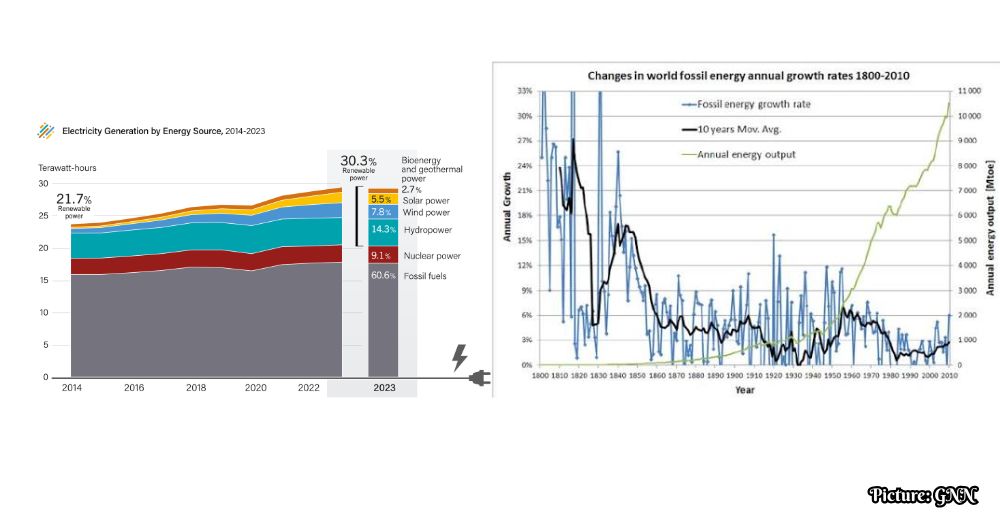
The latest analysis from Pew Research Center reveals a significant shift in global energy production, as renewable energy sources like wind and solar power gain market share at the expense of fossil fuels.
The global landscape of energy production is undergoing a significant transformation, marked by a notable increase in the adoption and utilization of renewable energy sources. According to a recent analysis conducted by the Pew Research Center, utilizing data from Ember, an independent think tank focused on global energy trends, the share of electricity generated from fossil fuels has seen a marked decline over the past two decades. As of 2025, fossil fuels account for 57% of global electricity generation, down from 65% in 2000, signaling a gradual but noteworthy shift towards more sustainable energy sources.
Shifting Dynamics of Coal and Renewables
Among fossil fuels, coal has experienced the most significant decline in its role in global electricity generation. In 2025, coal accounted for approximately 33% of all electricity produced globally, a sharp decrease from its peak of 41% in 2013. In contrast, renewable energy sources—comprising wind, solar, bioenergy, hydropower, geothermal, tidal, and wave energy—have collectively surpassed coal for the first time, contributing 34% to the global electricity mix in 2025. This marks a watershed moment in the global energy transition.
Wind and solar energy have emerged as the primary drivers of this transition. Together, they represented 17% of total global electricity generation in 2025, a substantial increase from less than 5% in 2015. This remarkable growth can largely be attributed to significant reductions in the cost of solar technology. The price of solar panels has plummeted by more than 99% since 1975, decreasing from an average of $128 per panel to just $0.26 in 2024. Such dramatic price reductions have catalyzed the rapid adoption of solar energy across the globe.
Regional Variations in Energy Production
The transition to renewable energy has not been uniform across regions. In the European Union, renewables have become the dominant source of electricity, contributing nearly half (48%) of total electricity generation in 2025. Meanwhile, countries like Saudi Arabia, which relied on fossil fuels for 98% of their electricity generation, are beginning to explore nuclear energy as part of their Vision 2030 plan aimed at reducing dependency on fossil fuels.
China stands out as a global leader in renewable energy production, generating more electricity from solar and wind than all 38 member countries of the Organisation for Economic Co-operation and Development (OECD) combined. In 2025, solar power alone contributed a staggering 36% of China’s electricity, with the country producing an impressive 1,174.94 terawatt-hours (TWh) from solar energy, reflecting an extraordinary increase in capacity over the years.
Impact of Rising Electricity Demand
Global electricity demand has more than doubled since 2000, primarily driven by rapid economic growth and urbanization in Asia, especially in China and India. By 2025, global electricity generation reached 31,734 TWh, with Asia accounting for a substantial portion of this growth. Notably, China’s electricity generation has skyrocketed by 680% over the past 25 years, contributing to over half (56%) of global demand growth during this period.
Despite the progress made in renewable energy adoption, the reliance on fossil fuels remains a critical component of the global energy landscape. The report highlights that while coal and natural gas usage has decreased in many regions, they continue to be prevalent in areas like Southeast Asia, where coal’s share of electricity generation more than doubled since 2000, reaching 45% in 2025.
Challenges and the Future of Energy Production
The transition to renewable energy is not without its challenges. The ongoing reliance on fossil fuels in certain regions underscores the complexities of global energy production. However, there are promising developments, such as the case of Pakistan, where renewable sources have recently overtaken fossil fuels in electricity generation, demonstrating the potential for significant change even in historically fossil fuel-dependent nations.
Looking ahead, the global community faces the dual challenge of meeting increasing energy demands while transitioning to a more sustainable energy future. The expansion and integration of renewable energy technologies will be crucial in addressing climate change and ensuring energy security. Furthermore, the development of supportive policy frameworks, investment in renewable technologies, and international cooperation will be vital in shaping the future of global energy production.
As nations strive to adapt to the changing energy landscape, the importance of renewable energy will continue to grow, influenced by technological advancements, market dynamics, and environmental considerations. The coming years will be pivotal in determining how effectively the world can transition to a sustainable energy future that balances economic growth with ecological integrity.





No Comment! Be the first one.