


Grassroots Investment Yields Historic Sweep as Youth Contingent Propels India to Dominance at Inaugural World Yogasana Championships in Ahmedabad

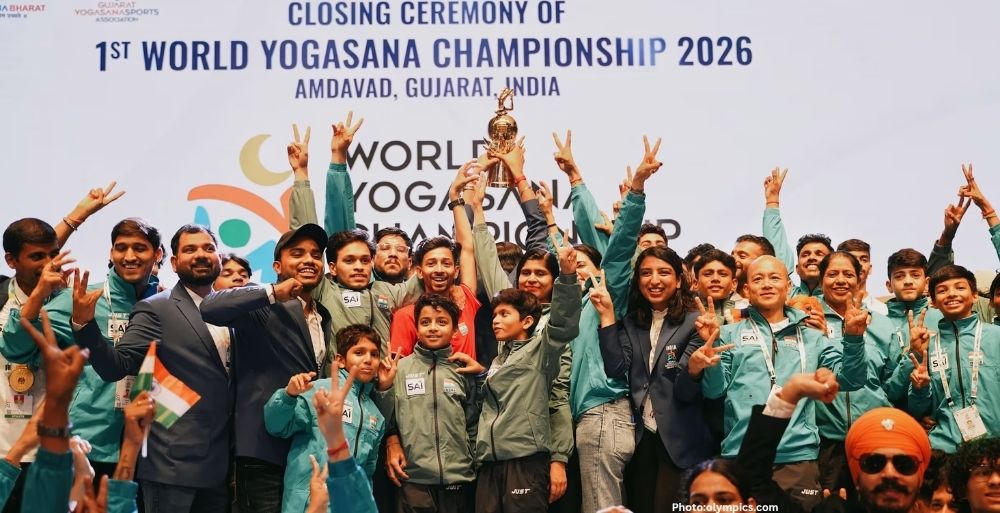
AHMEDABAD, India — The inaugural World Yogasana Championships concluded at the EKA Arena this week with a definitive display of athletic dominance by the host nation, solidifying India’s status as the foundational benchmark for the rapidly institutionalizing sport. Competing against a global field of 522 athletes representing 79 nations, the Indian national contingent claimed a historic total of 114 medals, including an extraordinary haul of 102 gold medals, nine silver, and three bronze medals. While senior competitors performed as expected, the primary narrative of the five-day tournament centered on India’s junior and sub-junior athletes. This youth cohort, colloquially dubbed the “Gen Z of Indian yogasana,” secured 46 of the nation’s 102 gold medals. Sports analysts and regulatory officials view this dynamic as proof of a highly structured talent pipeline resulting from years of deliberate grassroots development, school-level sports academies, and formal government backing designed to transform an ancient wellness practice into a globally recognized competitive discipline.
The Mathematics of Global Supremacy: Analyzing the Medal Standings
The performance of the 122-member Indian squad at the EKA Arena left little room for international rivalry, but the broader medal table highlights the expanding global footprint of competitive yogasana. While India secured more than half of the 181 gold medals on offer across all divisions, several international delegations established firm footholds in the sport.
Japan finished a distant second in the overall gold standings, securing three gold, three silver, and five bronze medals for an 11-medal total. Argentina claimed third place in the team standings, a placement driven almost entirely by the individual exploits of Nabila Barraza, who emerged as one of the most decorated non-Indian athletes of the tournament by capturing two gold and three silver medals.
Significantly, neighboring Nepal displayed impressive depth, finishing as the second-most successful country in terms of total volume with 52 medals, comprising one gold, 36 silver, and 15 bronze. Uzbekistan followed closely with a 25-medal haul (one gold, 13 silver, and 11 bronze), while Singapore also managed to secure two gold medals. A total of 31 nations successfully placed on the final medal table, demonstrating that competitive structured guidelines are taking root globally across Asia, Europe, South America, and Africa.
Emerging Stars of the Sub-Junior Circuit
Among the standout technical performances of the tournament was the gold-medal victory of 14-year-old Ishika Guchhait of Delhi and 12-year-old Sanwita Banerjee of Durgapur, West Bengal. Competing in the highly scrutinized sub-junior girls’ rhythmic pair discipline—where athletes are judged under strict rules governing synchronization, balance, flexibility, and transition speed—the young duo executed a flawless sequence to defeat international pairs from 78 other nations.
The background of the two gold medalists illustrates the diverse social tapestries feeding into India’s modern sports ecosystem. Ishika Guchhait’s family originally migrated from the rural Midnapore district of West Bengal before settling in Delhi, where her father earns a modest livelihood as a traditional paan (betel leaf) vendor. Her mother, an independent yoga instructor, introduced Ishika to the discipline at the age of nine.
During the strict stay-at-home mandates of the COVID-19 pandemic, Guchhait repurposed the family’s confined domestic living space into a training area. She focused specifically on mastering high-difficulty forward bending and architectural hand-balance postures.
Conversely, Sanwita Banerjee’s entry into competitive athletic movement began in industrial Durgapur. Initially enrolled in classical dance classes while her elder sibling trained in competitive gymnastics, Banerjee recognized her own physiological aptitude for flexibility-based sports and shifted her focus to yogasana. She balances her daily school curriculum and intense regional yogasana training regimes with competitive badminton.
In the rhythmic pair discipline, technical scoring requires both athletes to mirror or complement each other’s center of gravity with absolute precision. A single second of separation or an unstable posture can trigger severe point deductions from the international panel of judges. Observers in the arena noted that the level of composure and technical harmony displayed by Guchhait and Banerjee during their final sequence belied their ages.
Institutional Frameworks and the Drive for Olympic Inclusion
The tournament in Ahmedabad was not merely a standalone competitive meet; it serves as a critical milestone in a larger, state-backed geopolitical push to secure Olympic recognition for yogasana. The event operated under the joint regulatory auspices of Yogasana Bharat, World Yogasana, and the Indian Olympic Association (IOA), with direct institutional funding and administrative support provided by the Ministry of Youth Affairs and Sports, the Ministry of Ayush, the Sports Authority of India (SAI), and the Government of Gujarat.
| Governing / Sponsoring Agency | Strategic Operational Responsibility | Organizational Target |
| Ministry of Ayush | Regulatory Alignment & Standardization | Global Cultural Diplomacy Integration |
| Yogasana Bharat | Elite National Camp Management & Scouting | Infrastructure Scaling via Super League |
| Sports Authority of India (SAI) | Infrastructure Provisioning & Athlete Logistics | Targeted Development of Under-18 Pipeline |
| World Yogasana Federation | International Affiliate Scoping & Codification | Expansion toward 150 Member Nations |
| Indian Olympic Association (IOA) | Multi-Sport Event Lobbying & Direct Advocacy | Inclusion in 2036 Olympic Host Proposal |
To eliminate the subjectivity historically associated with yoga demonstrations, the tournament introduced a centralized Electronic Scoring System for the first time at a global level. This system allowed the 32 international judges and 51 national judges to score athletes in real time across precise, predefined parameters: flexibility, endurance, stability, posture retention, and transitional control.
The institutionalization of the sport is clear. Yogasana was successfully integrated into the Khelo India Youth Games in 2021 and was featured as a full medal discipline at the National Games in Uttarakhand. The sport’s leadership is openly utilizing these structured formats to prepare for inclusion in major multi-sport events, specifically pointing toward India’s active bid to host the 2036 Summer Olympic Games.
Executive Perspectives on Grassroots Infrastructure
Speaking from the administrative headquarters at the EKA Arena following the closing ceremonies, Jaideep Arya, Secretary General of World Yogasana and Yogasana Bharat, emphasized that the youth cohort’s performance represents a validation of India’s systemic coaching investments rather than a random collection of individual talents.
“The performance of India’s junior and sub-junior athletes at the inaugural World Yogasana Championship in Ahmedabad is truly inspiring,” Secretary General Arya stated during a formal press briefing. He maintained an authoritative yet encouraged demeanor as he referenced the official final statistics. “Winning 46 gold medals out of India’s total 102 gold medals not only demonstrates exceptional talent and dedication, but it also reflects the strong foundation that has been built for yogasana sport in this country.”
Arya expanded on the long-term strategic utility of the junior development camps, which included an intensive training program at the SAI Veer Savarkar Sports Complex in Ahmedabad leading up to the competition under Chief Coach C.K. Mishra.
“What is most encouraging is that these achievements have come from our youngest athletes,” Arya added. “Their success reflects the effectiveness of our grassroots development and coaching systems and the growing acceptance of Yogasana as a competitive sport. As we move forward towards greater international recognition, including participation in major multi-sport events, these athletes represent India’s strongest asset. Their discipline, commitment and excellence on the world stage reaffirm that the future of Indian yogasana sport is indeed in safe hands.”
As the domestic federation prepares to launch the upcoming Yogasana Super League to further commercialize the sport, sports administrators acknowledge that international fields will grow increasingly competitive. Chief Coach C.K. Mishra noted that as foreign nations adopt India’s training blueprints, the gap in performance will inevitably narrow—a trend previously seen in traditional sports like field hockey following changes in playing surfaces. However, the data from Ahmedabad suggests that India’s proactive investment in its sub-junior pipeline provides the country with a substantial competitive head start.


No Comment! Be the first one.