





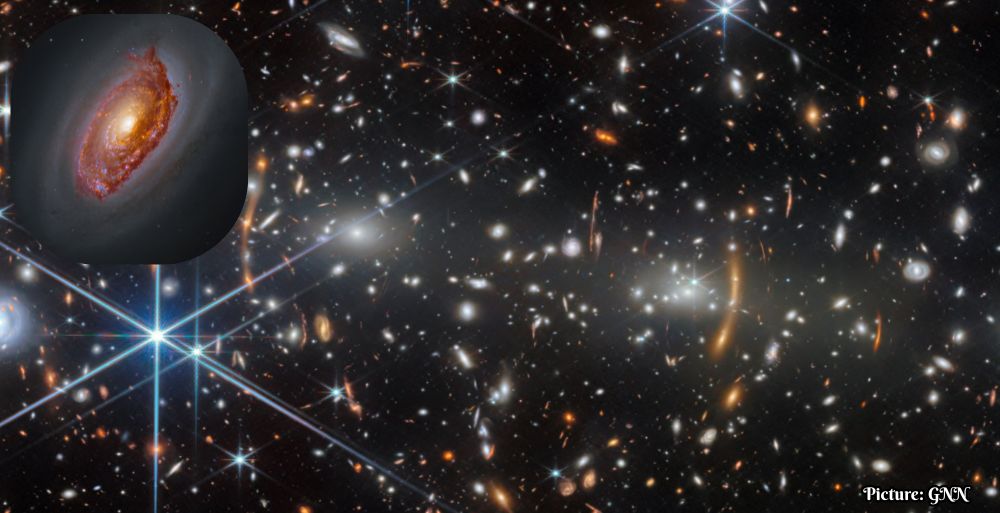
The collaboration between NASA’s Hubble Space Telescope and the James Webb Space Telescope has resulted in a remarkable composite image of the Black Eye Galaxy, showcasing the unique features of this celestial body located 17 million light-years from Earth.
The Hubble Space Telescope (HST) and the James Webb Space Telescope (JWST) have successfully teamed up to create a striking composite image of the Black Eye Galaxy, scientifically known as Messier 64. This collaboration highlights the complementary strengths of these advanced observational instruments, providing a more comprehensive understanding of the galaxy’s intricate structure and dynamics.
Overview of the Black Eye Galaxy
Located approximately 17 million light-years away in the constellation Coma Berenices, which translates to “Berenice’s Hair” in Latin, the Black Eye Galaxy has been a subject of fascination for astronomers since its discovery in 1779. The galaxy is distinguished by a prominent dark band of dust that gives it its memorable nickname, evoking the appearance of a ‘black eye.’ This feature, easily visible through small telescopes, draws the attention of both professional and amateur astronomers alike.
The Black Eye Galaxy is classified as a spiral galaxy, but it possesses a unique characteristic that sets it apart: the gas in its outer regions rotates in the opposite direction to the gas and stars closer to its core. This counter-rotational motion creates a complex internal dynamic that continues to intrigue astrophysicists, as researchers seek to understand the underlying mechanisms that drive such behavior.
Technological Collaboration
The composite image of the Black Eye Galaxy was produced by integrating observations from both HST and JWST. The JWST contributed near and mid-infrared data, allowing for deeper insights into the galaxy’s structure obscured by interstellar dust. Meanwhile, Hubble provided ultraviolet, visible, and near-infrared observations, delivering high-resolution images that highlight the galaxy’s features.
This synergistic approach demonstrates the necessity of utilizing multiple advanced observational technologies in contemporary astronomy. Each telescope has its own unique capabilities: Hubble excels in capturing high-resolution images across the ultraviolet and visible spectra, while JWST is specifically designed to detect infrared signals, enabling it to penetrate the dusty regions of space where many celestial phenomena reside.
Significance of the Collaboration
The partnership between HST and JWST exemplifies the broader trend in modern astronomy where collaboration among different instruments enhances scientific inquiry. As we anticipate the launch of NASA’s upcoming Nancy Grace Roman Space Telescope, the recent collaboration highlights the importance of integrating various observational capabilities to unravel the complexities of the universe.
The Black Eye Galaxy stands out not only for its intriguing characteristics but also for its accessibility to amateur astronomers. Its visibility through smaller telescopes allows a wider audience to engage with and appreciate the wonders of the cosmos. This accessibility fosters a greater public interest in astronomy and encourages the next generation of scientists and enthusiasts to explore the universe.
Implications for Future Research
The new composite image of the Black Eye Galaxy not only enriches our visual understanding of this intriguing celestial body but also serves as a reminder of the ongoing exploration of our universe. The collaboration between Hubble and JWST not only reflects the spirit of scientific inquiry but also underscores the importance of shared knowledge and resources in achieving groundbreaking discoveries.
The advancements in telescope technology and the commitment to expanding our understanding of cosmic phenomena continue to motivate researchers and enthusiasts alike. As the scientific community looks ahead, the partnership between Hubble and JWST exemplifies how collaborative efforts can yield extraordinary results in the field of astronomy.
A Broader Perspective on Cosmic Exploration
The exploration of galaxies like the Black Eye Galaxy provides crucial insights into the formation and evolution of galaxies in the universe. Studies of such celestial bodies can inform theories about dark matter, galaxy interactions, and the lifecycle of stars. As researchers analyze the data collected from this composite image, they will continue to piece together the cosmic puzzle of how galaxies like Messier 64 fit into the grand tapestry of the universe.
With the anticipation surrounding future missions and observatories, including the Nancy Grace Roman Space Telescope, the ongoing collaboration between HST and JWST underscores the dynamic and ever-evolving nature of astronomical research. The insights gained from these powerful telescopes will not only enhance our understanding of the Black Eye Galaxy but also contribute to a broader comprehension of the universe as a whole.
Conclusion
The Black Eye Galaxy, with its captivating appearance and complex dynamics, remains a focal point for both professional and amateur astronomers. The recent collaborative effort between the Hubble Space Telescope and the James Webb Space Telescope stands as a testament to the power of advanced technology and teamwork in the pursuit of knowledge. As we continue to explore the cosmos, the insights gained from such collaborations will pave the way for future discoveries, igniting curiosity and inspiring generations to come.






No Comment! Be the first one.