



Health care experts, medical researchers, and practitioners from the United States, India, the United Kingdom, and Mauritius gathered in Chestnut Hill, Massachusetts, to celebrate International Ayurveda Day 2026. The half-day symposium, titled “Reimagining Global Well-Being Through Ayurveda,” focused on blending traditional Eastern healing practices with modern Western clinical research. Hosted at a prominent facility affiliated with Harvard Medical School, the event highlighted evidence-based integrative health, nervous-system regulation, whole-plant medicine, and strategies for healthy longevity. Public officials, including the Mayor of Peabody, issued official proclamations recognizing the role of traditional medicine in preventive global health.
CHESTNUT HILL, Mass. — Medical professionals, academics, and research scientists assembled at the Brigham and Women’s Health Care Center in Chestnut Hill on International Ayurveda Day 2026 to evaluate the evolving role of traditional medicine in modern clinical practice.
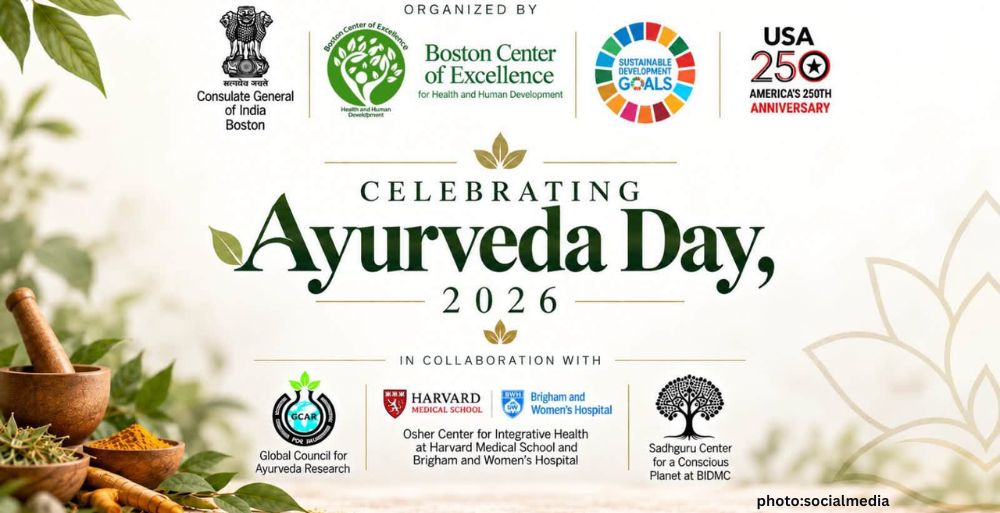
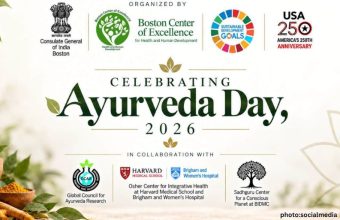
The symposium, titled “Reimagining Global Well-Being Through Ayurveda,” was organized by the Boston Center of Excellence for Health & Human Development (BoCE). The venue, affiliated with Brigham and Women’s Hospital and Harvard Medical School, served as a symbolic bridge between ancient health frameworks and contemporary academic medicine.
The gathering convened an international cohort of physicians, researchers, Yoga scholars, and health care entrepreneurs from the United States, India, the United Kingdom, and Mauritius. Discussions centered on preventive health care, mental well-being, evidence-based integrative medicine, and the deployment of emerging technologies to support lifelong health.
Institutional Collaboration and Ceremonial Opening
The program was executed with the direct support and participation of the Consulate General of India in Boston. Institutional collaborators included the Global Council for Ayurveda Research (GCAR), the Osher Center for Integrative Health at Harvard Medical School and Brigham and Women’s Hospital, and the Sadhguru Center for a Conscious Planet at Beth Israel Deaconess Medical Center.
The formal proceedings began with traditional Dhanvantari and Saraswati invocations led by Pratibha Shah, founder of GCAR, accompanied by practitioner Sharanya. Following the recitations, delegates conducted a ceremonial lamp-lighting ceremony to mark the official opening of the symposium.
Pramit Maakoday, co-founder of BoCE and host of the symposium, opened the proceedings by detailing his organization’s decade-plus effort to establish common ground between Eastern medical traditions and Western healthcare models.
“Our goal is to explore affordable, accessible and quality healthcare solutions by bringing together modern medicine, Ayurveda, Yoga, preventive care, mental well-being and emerging technologies to help people live happier and healthier lives beyond 100,” Maakoday said addressing the audience.
Maakoday’s opening remarks set the stage for a series of technical panels focused on nervous-system regulation, mind-body health, whole-plant therapeutics, and peer-reviewed research methodologies.
Evidence-Based Integrative Health and Academic Research
A primary focus of the symposium was establishing rigorous scientific standards for non-Western medical interventions. Dr. Bala Subramaniam and Dr. Darshan Mehta, both representing Harvard Medical School, delivered joint presentations on mind-body health and clinical approaches to integrative medicine. Their discussions emphasized the necessity of clinical trials and objective biomarkers to validate traditional therapeutic claims.
Representing international educational institutions, Dr. Tanuja Nesari, director of the Institute of Teaching and Research in Ayurveda (ITRA) in Jamnagar, India, detailed ongoing research initiatives and cross-border academic collaborations. Dr. Nesari highlighted the importance of standardized medical curricula and international research networks in establishing global trust in Ayurvedic treatments.
Additional academic perspectives were presented by international specialists:
- Dr. Krishna Bhatta, FRCS (London): Presented his structured “Krishna’s 5 Yuktas” framework, which outlines systematic steps for integrating mental clarity, physical discipline, and preventive habits into routine medical care.
- Dr. Jay Glaser: Delivered a session on whole-plant medicine, analyzing how botanical compounds interact with human biological systems compared to isolated synthetic pharmaceuticals.
- Dr. Pooja Sabharwal: Shared operational perspectives from Mauritius, detailing how Ayurvedic principles have been incorporated into national health and well-being policies in the island nation.
Connecting virtually from India, Dr. H. R. Nagendra, founder and chancellor of S-VYASA University, delivered a special keynote address emphasizing the combined application of Yoga and Ayurveda in reducing the global burden of non-communicable diseases. From the United Kingdom, advocate Amarjit Singh Bhamra addressed the assembly on policy strategies to integrate traditional medicine into national public health frameworks across Europe.
Longevity, Technology, and Civic Recognition
The afternoon sessions centered on healthy aging through a dedicated “Beyond 100” curriculum, which examined strategies for maintaining cognitive and physical function into advanced age.
Rajarshi B. K. Modi presented his strategic blueprint for a “Happy, Healthy, Wealthy and Purposeful Life Beyond 100.” His presentation framed longevity not merely as the extension of lifespan, but as the preservation of healthspan—ensuring older adults retain operational independence and mental vitality.
Complementing the focus on traditional practices, Massachusetts-based technology entrepreneur Anil Shah discussed the role of innovation in scaling preventive care. Shah outlined how wearable technology, biological monitoring, and artificial intelligence can track physiological parameters in real time, allowing individuals to tailor Ayurvedic and lifestyle regimens with high precision.
Throughout the event, attendees examined a curated exhibition of recent books, clinical journals, and research publications detailing contemporary advances in Ayurveda, Yoga, and integrative medicine.
Highlighting the civic impact of the event within Massachusetts, the Mayor of Peabody issued an official municipal proclamation declaring Ayurveda Day within the city, citing the growing interest in evidence-based preventive care and holistic health among local residents. The proclamation joins a broader movement of regional recognitions aimed at promoting health literacy and diverse medical traditions.


No Comment! Be the first one.