





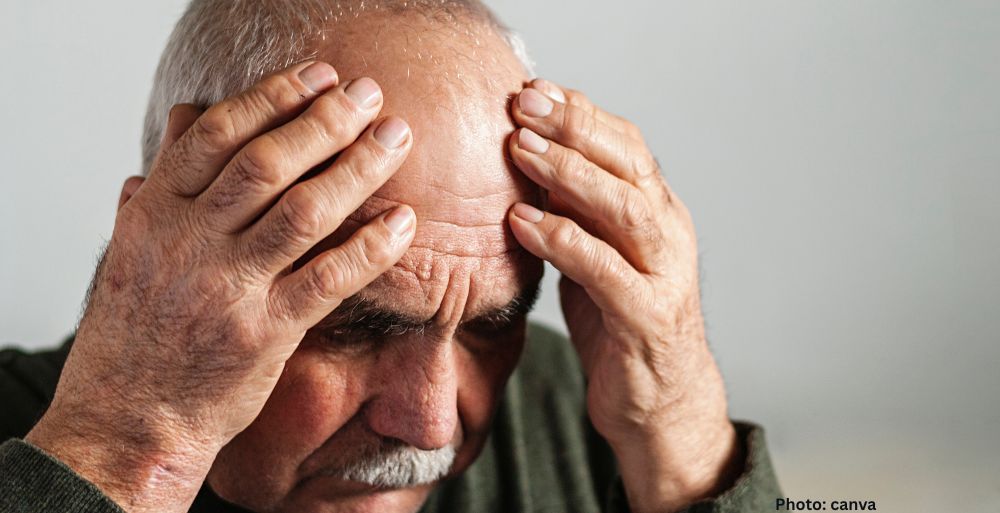
As India ages, dementia is moving from the margins of private family life to the centre of a national conversation. A new conclave in Delhi is asking a larger question: are we building a society in which our parents and grandparents can age with dignity, and can their families get the care they need?
There are some health crises that arrive with sirens.
And then there are those that enter a family quietly, through a forgotten name, a repeated question, a missed appointment, a familiar road suddenly becoming unfamiliar.
Dementia is one of them.
For years, India has largely treated dementia as a private family matter: something to be managed at home, spoken about in hushed tones and, too often, dismissed as an inevitable consequence of growing old.
It isn’t.
Dementia is not a normal part of ageing. It is an umbrella term for conditions that affect memory, thinking, communication and the ability to carry out everyday activities. And as India’s older population expands, the question is no longer whether more families will encounter dementia. It is whether the country will be prepared when they do.
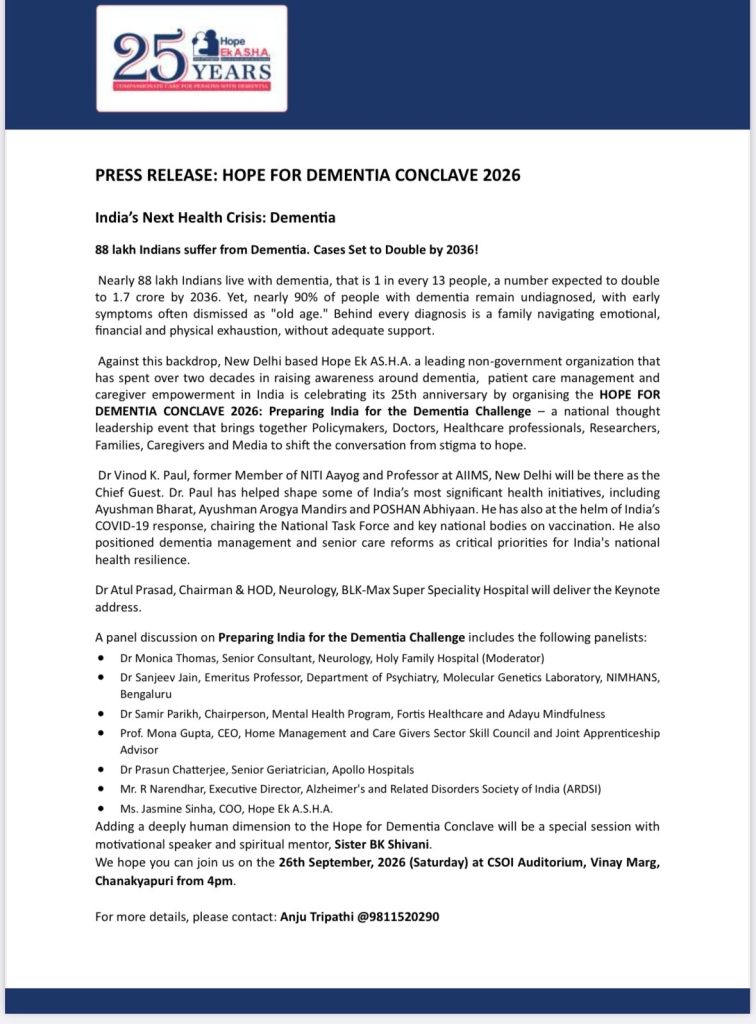
That is why the Hope for Dementia Conclave 2026, held in New Delhi on September 26, assumes significance beyond being another conference on a health condition.
It is an attempt to move dementia from the drawing room to the mainstream, from something families struggle with privately to an issue that doctors, policymakers, caregivers, researchers, communities and the media must confront together.
The conclave is being organised by Hope Ek A.S.H.A., which is completing 25 years of work around dementia awareness, care management and caregiver empowerment. Its programme brings together policymakers, neurologists, psychiatrists, geriatricians, researchers, caregivers and civil-society voices. Dr Vinod K. Paul is the chief guest and Dr Atul Prasad is delivering the keynote, while the central discussion, Preparing India for the Dementia Challenge, brings together professionals including Dr Monica Thomas, Dr Sanjeev Jain of NIMHANS, Dr Samir Parikh, Prof. Mona Gupta, Dr Prasun Chatterjee, R. Narendhar of ARDSI and Jasmine Sinha of Hope Ek A.S.H.A. A special session with Sister BK Shivani adds another dimension to the conversation around emotional and spiritual resilience.
But perhaps the most interesting part of this story is not the list of eminent names.
It is why a movement like this has had to be built in the first plac. The number that should make every Indian family pause. A nationwide study using data from the Longitudinal Ageing Study in India estimated that 7.4% of Indians aged 60 and above , approximately 8.8 million people, were living with dementia. If prevalence remains constant, demographic changes alone could take that number to about 16.9 million by 2036.
That is not simply a medical statistic.
Behind every number is a spouse who may suddenly become a full-time caregiver; an adult child trying to balance a job and an ageing parent; a family negotiating finances, safety and medication; and sometimes a person who slowly stops recognising the home, routines and people that once defined their world.
India’s demographic arithmetic makes the challenge even more urgent. WHO’s India healthy-ageing data shows that people aged 60 and above constituted about 11% of India’s population in 2024, with that share projected to reach 21% by 2050.
So dementia care cannot remain an issue for a handful of specialist hospitals.
It has to become part of the architecture of ageing.
We sometimes perceive symptoms and we are too quick to call “old age”
The first signs can be deceptively ordinary.
A parent repeatedly asks the same question.
Someone who has always managed household finances begins making unusual errors.
A person gets lost on a route travelled for years.
Words that once came easily become difficult to retrieve.
A familiar recipe becomes confusing.
Bills are left unpaid.
Objects are repeatedly misplaced.
There may be changes in judgement, mood, personality or social behaviour.
None of these signs, individually, proves dementia. There can be other medical explanations, and proper clinical assessment matters. But persistent changes that interfere with everyday life should not simply be written off as ageing. WHO and the CDC list memory problems, difficulty with familiar tasks, language problems, disorientation, impaired judgement and withdrawal among recognised warning signs.
And that is where awareness becomes intervention.
Early recognition gives families a chance to seek assessment, understand what is happening, plan care and make informed decisions while the person can still participate meaningfully in them.
The conversation therefore needs to change from:
“Mummy is getting forgetful.”
to:
“This is different from how she used to be. Should we get it checked?”
That one shift can matter enormously.
Because dementia doesn’t happen to one person.
One of the most poorly understood dimensions of dementia is that it affects an entire ecosystem around the person.
The caregiver may gradually become the scheduler, driver, medication manager, financial guardian, cook, companion and crisis manager.
And unlike an acute illness, dementia can demand this support over years.
Research on caregivers in India describes the condition’s psychosocial and economic consequences for patients, families and caregivers, alongside stigma and barriers to diagnosis and care.
International experience tells a similar story. A 2025 Alzheimer’s Society survey of almost 3,500 people affected by dementia in England, Wales and Northern Ireland found that 70% of unpaid carers reported negative effects on their mental or physical health, social life or activities they enjoyed.
The lesson for India is not that the systems are identical. They aren’t.
The lesson is that the caregiver cannot remain the invisible patient in dementia care.
A dementia strategy that treats only the neurological condition but ignores caregiver training, respite, counselling, financial planning, legal support and social infrastructure will inevitably be incomplete.
From “put them in a home” to “build a continuum of care”
One of the most important changes underway is a rethinking of what dementia care actually means.
It isn’t necessarily hospitalisation.
It isn’t necessarily residential care.
And it certainly isn’t abandonment.
Depending on the stage and circumstances, care may include medical assessment, medication management, cognitive and physical activities, occupational support, caregiver training, home-based care, day-care programmes, respite and specialised residential care.
Hope Ek A.S.H.A.’s own model illustrates this continuum. Its Delhi centre provides day and residential dementia care, trained caregivers and medical supervision, while its outreach includes memory camps, awareness programmes, caregiver training and online/home-care support.
That model matters because India does not need only more beds.
It needs more trained people, more dementia-friendly communities and more points of support before a family reaches crisis.
There are encouraging signs that the landscape is beginning to move.
In September 2026, Tata Trusts launched Vajood Rahe Maujood, an awareness campaign focused on early detection and action at an ecosystem level.
And in Bengaluru, a new dementia-friendly community initiative involving Dementia India Alliance and NIMHANS has been launched in Shantinagar, focusing on awareness, accessibility and community support.
These are small but significant indicators of a larger transition: dementia care is beginning to move beyond the clinic.
India can learn from what the world has already discovered
Countries with more established dementia-care systems have increasingly recognised that diagnosis is only the beginning.
The UK, for instance, has been working on dementia-care navigators, multidisciplinary services and more integrated pathways between health and social care. Research into dementia-care inequities has identified care navigation as one mechanism that can help families move through a complicated system.
The important lesson for India is not to replicate another country’s model wholesale.
It is to ask what an Indian version should look like.
Can a family in a Tier-II city find a trained caregiver?
Can a primary-care doctor recognise early cognitive decline?
Can a spouse get respite without having to become financially devastated?
Can dementia-friendly transport, neighbourhoods
and public spaces become part of urban planning?
Can families access culturally and linguistically appropriate support?
Can care homes be evaluated not merely by accommodation but by training, safety, clinical oversight, cognitive engagement and dignity?
These are the questions that will determine whether India’s ageing story becomes merely longer , or genuinely better.
In that context, the Hope for Dementia Conclave 2026 is significant not simply because it brings experts and stakeholders into one room, but because it reflects the conversation India now needs to have at scale. Its focus on awareness, early recognition, caregiver support, care pathways and community participation points to a shift from treating dementia as a private family burden to recognising it as a shared public-health and social-care challenge. If the country is preparing for a much larger ageing population, conversations like these are an important starting point for asking what dignity in later life should actually look like, for the person living with dementia, and for the families who walk alongside them.




No Comment! Be the first one.