




10-Year-Old Japanese Student Jo Nagai Challenges Insect Memory Assumptions with Butterfly Research

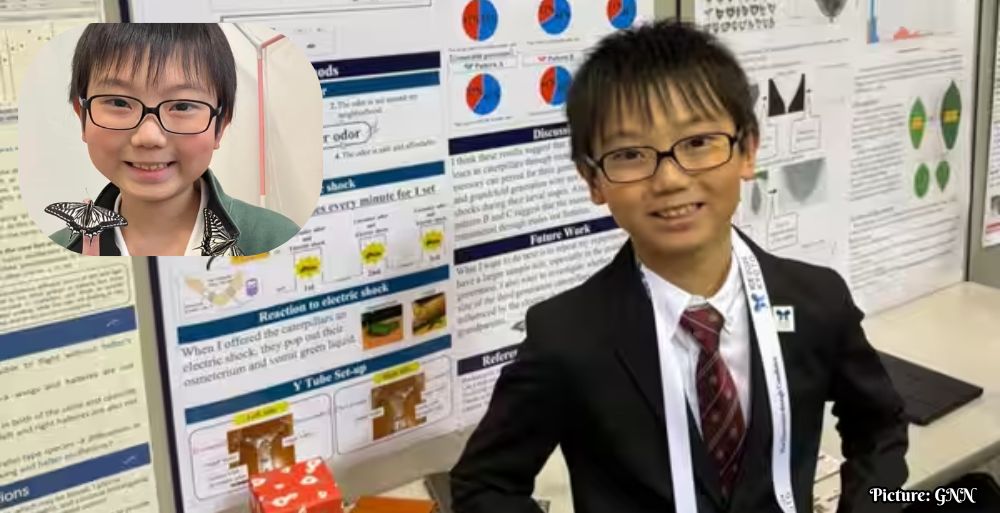
A 10-year-old student from Japan, Jo Nagai, has gained international attention for his groundbreaking research on butterfly memory, suggesting that some memories formed as caterpillars may survive metamorphosis.
In an extraordinary blend of childhood curiosity and scientific investigation, Jo Nagai, a 10-year-old elementary school student from Kobe, Japan, has captured global attention with his research on butterfly cognition. His inquiries into the Asian swallowtail butterfly challenge long-standing assumptions in the field of entomology regarding memory retention across metamorphosis, suggesting that some memories formed during the caterpillar stage may persist into adulthood.
Jo’s fascination with insects began early in his childhood, leading him to raise butterflies at home and meticulously document their behavior. His passion culminated in a pivotal observation: while wild butterflies typically flee when approached, the butterflies he reared often returned to his hand even after being released. This unusual behavior prompted Jo to question whether memories formed during the caterpillar stage could persist beyond the life-altering process of metamorphosis.
Research Background and Methodology
Motivated by his observations, Jo formulated a series of experiments aimed at investigating his hypothesis. His methodology was innovative for a young researcher; he exposed swallowtail caterpillars to the scent of lavender while simultaneously applying a mild vibration stimulus using a muscle-therapy device. Following their transformation into butterflies, Jo tested them using a Y-shaped tube maze designed to evaluate their responses to the lavender scent.
According to Jo’s preliminary findings, approximately 70% of the adult butterflies avoided the lavender scent. This result suggests a retention of memories formed during their caterpillar phase, posing significant questions about insect memory and cognition, as it contradicts the traditional belief that an insect’s nervous system is entirely rebuilt during its pupal stage, supposedly erasing all previous memories.
Transgenerational Memory and Epigenetics
One of the most intriguing components of Jo’s research involves the possibility of transgenerational memory. After breeding the conditioned butterflies, Jo reported that their offspring, and even grandchildren, exhibited a heightened aversion to the lavender scent despite never having been directly exposed to the original conditioning. He posited that this behavior could potentially be explained by transgenerational epigenetic inheritance, a process in which environmental experiences may influence subsequent generations without altering DNA sequences.
However, scientists have cautioned that this conclusion remains preliminary and requires validation through further independent research before it can be broadly accepted within the scientific community. The implications of such findings, if verified, would represent a groundbreaking shift in our understanding of how memories and learned behaviors can be transmitted across generations.
Scientific Community Response
Jo’s work has generated significant interest among entomologists and researchers, especially as it aligns with an emergent body of scientific literature exploring memory retention in insects post-metamorphosis. His findings were presented at the International Congress of Entomology held in Kobe, where they were met with both intrigue and skepticism from professional scientists. While the discussions around his work have been robust, it remains unpublished in a peer-reviewed scientific journal, highlighting the necessity for replication and validation by external researchers.
Experts regard Jo’s contributions as impressive for a young researcher, yet they emphasize the importance of independent verification. The scientific community is keenly aware that while Jo’s work opens new avenues for inquiry, it is essential to approach these findings with caution until they can be reliably reproduced.
Public Reception and Ethical Considerations
The rapid dissemination of Jo’s story across social media platforms underscores both the wonder of childhood exploration and the ethical dimensions of scientific inquiry. Many viewers have expressed admiration for Jo’s initiative, noting that he produced a detailed 33-page research paper and successfully presented his findings to seasoned scientists. Videos showcasing Jo’s presentations have garnered millions of views, reflecting widespread public interest and admiration for his dedication and scientific thinking.
Conversely, the ethical implications of employing an aversive stimulus in his experiments have sparked debate online. Critics have raised concerns about the morality of using such methods on caterpillars, while supporters have defended the procedures, arguing that they were designed to elicit natural defensive responses rather than intentionally harm the insects. This discourse highlights the broader ethical considerations that accompany scientific experimentation, especially when it involves living organisms.
Future Implications and Inspiration
If subsequent studies corroborate Jo’s findings, they could significantly enhance current understanding of insect memory, metamorphosis, and the potential role of epigenetics in the transmission of learned behaviors across generations. Such insights might not only transform our comprehension of insect cognition but could also have implications for broader biological and psychological theories regarding memory and learning.
Jo Nagai’s research exemplifies how keen observation and a thirst for knowledge can lead to significant scientific inquiries, regardless of age. His journey serves as an inspirational narrative for young aspiring scientists worldwide, encouraging them to pursue their curiosities, pose thoughtful questions, and engage with science through observation and experimentation. This story resonates powerfully in an era characterized by a growing emphasis on STEM education and the importance of fostering scientific literacy among the youth.




No Comment! Be the first one.