





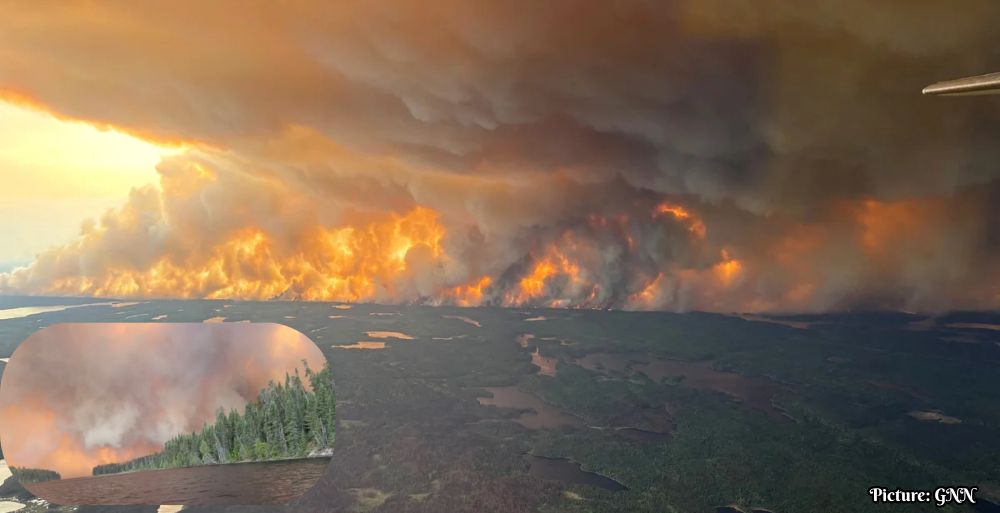
Wildfires in Canada have led to hazardous air quality across parts of the United States and Canada, prompting political responses and evacuation orders as officials grapple with the escalating crisis.
As of Friday morning, smoke from hundreds of wildfires in Canada and parts of Minnesota has resulted in unhealthy air quality for millions, triggering air quality alerts from the upper Midwest to the Northeast. The hazardous conditions are particularly severe in cities such as Toledo, Detroit, Milwaukee, and New York City.
The proliferation of wildfires has raised alarm throughout the affected regions, with over 180 fires reported in Ontario alone. A recent update from Ontario’s Ministry of Natural Resources indicated that 20 new fires ignited overnight, with many existing fires burning uncontrollably. The ministry’s interactive forest fire map reveals an escalating situation, with 80 of these fires categorized as out of control.
Air Quality Concerns
Air quality is deemed hazardous when the Air Quality Index (AQI) exceeds 300, a threshold that was surpassed in several cities on Thursday, including Toledo and Milwaukee, where readings went above 500. By Friday morning, air quality readings remained poor, though some improvements were noted. In Washington, D.C., the AQI reached 246, categorized as “very unhealthy,” with visibility reduced to near one mile due to dense smoke.
Political Reactions
The worsening air quality has incited political responses, particularly from U.S. lawmakers. A group of Republican congressional members from Michigan sent a letter to Canadian Prime Minister Mark Carney on Wednesday, criticizing Canada’s wildfire management and threatening punitive measures if action is not taken. Senator Bernie Moreno of Ohio plans to introduce legislation aimed at penalizing Canada for what he termed an “atrocity.” Meanwhile, Prime Minister Carney has yet to respond to these allegations, emphasizing that the responsibility for managing forest fires lies primarily with provincial governments.
Carney acknowledged the significant disruptions caused by the wildfires, stating, “Thousands of Canadians’ lives have been upended,” during a public appearance in London, Ontario. He also pointed out that the Royal Canadian Air Force is providing assistance, but the federal government has limited authority to intervene in provincial matters related to forest management and firefighting.
The Impact of Climate Change
The ongoing wildfires highlight the broader implications of climate change, which has been linked to an increase in the frequency and intensity of such events. As temperatures rise globally, the likelihood of hot and polluted days has also increased, leading to more frequent occurrences of poor air quality. Researchers have noted a dramatic increase in wildfires across North America, with climate scientists warning that the current haze is likely a precursor to more severe environmental challenges.
Jonathan Overpeck, a climate scientist at the University of Michigan, remarked that the current conditions are indicative of a worsening trend. “As long as humans continue to burn fossil fuels, global temperatures will increase, droughts will worsen, and there will be bigger, more frequent wildfires and smoke events,” he stated.
Community Responses and Evacuations
As the situation escalates in Ontario, evacuation orders have been issued for several rural communities near Thunder Bay, where some of the largest fires are burning. The fires have forced the evacuation of at least 15 communities, impacting over 1,500 residents, including many Indigenous families residing in remote areas that are particularly vulnerable to natural disasters.
Ontario officials have formally requested federal assistance to expedite evacuations and deploy resources to combat the fires. Ontario’s Minister for Emergency Preparedness, Jill Dunlop, confirmed the request for federal support, stating that the province is prepared to utilize military resources if necessary.
The Broader Context of Wildfire Management
The division of responsibilities between Canadian federal and provincial governments complicates the response to wildfires. While the federal government can intervene in national parks and military bases, the majority of forest management and firefighting efforts fall under provincial jurisdiction. This has led to calls for a more unified approach to wildfire management, although opinions on the efficacy of a national firefighting force remain divided.
Despite criticisms of forest management, it is important to recognize that the United States also faces significant wildfire challenges, with over 150 new fires reported nationwide in recent days. The U.S. National Interagency Fire Center has emphasized ongoing cooperation with Canadian firefighting efforts.
The political rhetoric surrounding these wildfires underscores the interconnectedness of environmental issues across borders. As smoke from Canadian wildfires drifts southward, it serves as a reminder of the shared responsibility in addressing climate change and its multifaceted impacts.
Conclusion
The situation remains dynamic, with weather patterns expected to shift, potentially alleviating some smoke conditions in the short term. However, the long-term implications of climate change on wildfire frequency and intensity continue to pose significant challenges for both Canada and the United States.





No Comment! Be the first one.