




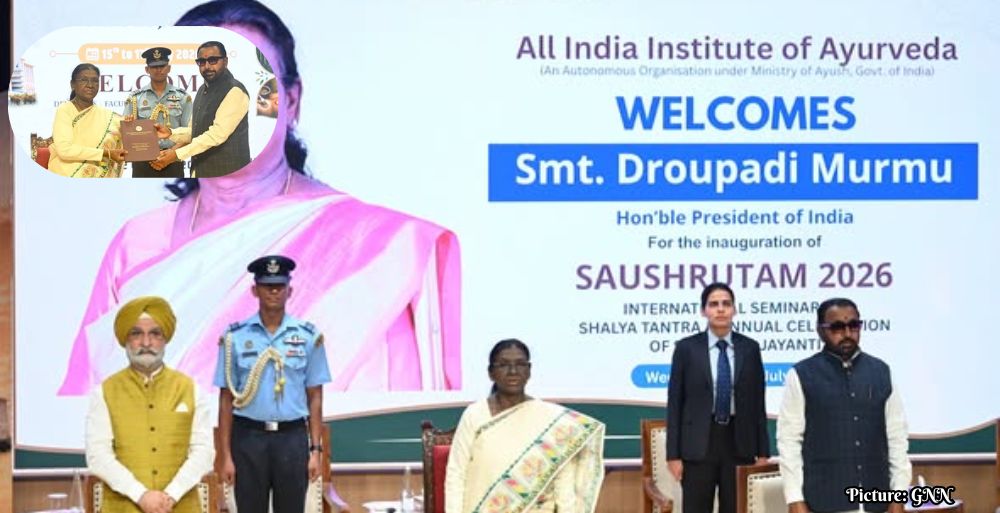
During the inauguration of Saushrutam 2026, President Droupadi Murmu highlighted the importance of integrating traditional Ayurvedic practices with modern scientific research while advocating for increased women’s participation in the field.
New Delhi, July 15, 2026 – President Droupadi Murmu inaugurated Saushrutam 2026, a three-day international seminar focused on Ayurvedic surgery, at the All India Institute of Ayurveda (AIIA) on the occasion of Acharya Sushruta Jayanti. This significant event has brought together surgeons, researchers, and policymakers from both India and nine other countries, underlining the growing global interest in Ayurvedic practices.
In addition to the seminar, President Murmu launched a state-of-the-art AI-enabled 3 Tesla High-Field MRI facility at the AIIA, aimed at enhancing diagnostic capabilities and integrating modern technology with traditional Ayurvedic methodologies. The inauguration also included the release of a pivotal study by the National Commission for Indian System of Medicine (NCISM) that examines the professional careers of women graduates in Ayurveda, highlighting the need for greater support and opportunities in this domain.
Historical Context and Contributions of Acharya Sushruta
Acharya Sushruta, often referred to as the ‘father of surgery’, made groundbreaking contributions to surgical practices in ancient India. His work, particularly in the field of Shalya Tantra (surgery), laid foundational principles that continue to influence modern surgical techniques. In her address, President Murmu acknowledged these contributions, asserting that Sushruta’s legacy forms the basis for scientific surgical practices today. She emphasized the importance of preserving biodiversity and ensuring a sustainable supply of medicinal plants essential for Ayurvedic practices.
“Integrating traditional knowledge with modern diagnostics and research is critical for enhancing Ayurveda’s global credibility,” President Murmu stated. Her remarks reflect a broader commitment to fostering an inclusive and scientifically validated approach to Ayurvedic medicine, a sentiment echoed by many in the growing field of integrative health.
Advocacy for Women’s Participation
In her speech, President Murmu called for increased participation of women in the Ayurveda workforce, urging stakeholders to address the barriers that women face in establishing long-term careers in this field. She noted that empowering women is not only a matter of equity but also vital for the overall growth and sustainability of Ayurveda. This call aligns with ongoing discussions about gender equality in healthcare professions, where women have historically been underrepresented.
Delhi Lieutenant Governor Taranjit Singh Sandhu, who also spoke at the seminar, praised Ayurveda as one of India’s most enduring knowledge traditions. Sandhu emphasized the need for stronger research initiatives and international collaboration to elevate the field, calling on experts to contribute to a more robust body of evidence supporting Ayurvedic practices.
Government Support for Ayurveda
Union Minister of State for Ayush, Prataprao Jadhav, highlighted the government’s commitment to advancing Ayurveda on a global scale through supportive policies. He stated that the seminar aims to enhance the standards of Ayurvedic surgery while fostering an environment conducive to research and development. Jadhav stressed the importance of policy support to bolster women’s participation in Ayurveda, asserting that it is crucial for the sector’s growth.
P. K. Prajapati, director of AIIA, remarked that Saushrutam 2026 serves as a platform to strengthen academic collaboration and clinical excellence within Ayurvedic practice. He noted that the event represents a significant step towards enhancing the quality of education and practice in Ayurveda, promoting a synthesis of ancient wisdom with contemporary scientific advancements.
International Participation and Knowledge Exchange
Saushrutam 2026 has attracted participants from nine countries, including Thailand, Israel, Austria, and the United Kingdom. The seminar features a comprehensive agenda, including sessions on various Ayurvedic specialties such as Shalya Tantra (surgery), Kshara Sutra (surgical management), Agnikarma (cauterization), and integrative oncology. These sessions aim to facilitate knowledge exchange and foster collaboration among international practitioners, reflecting a commitment to global health dialogue.
The international presence at the seminar underscores Ayurveda’s potential to contribute to global health systems. As countries increasingly seek holistic and integrative approaches to healthcare, Ayurveda stands poised to play a significant role. Events like Saushrutam 2026 are crucial in advancing the recognition and practice of Ayurveda on a global platform, reinforcing India’s commitment to its traditional medical systems while adapting to contemporary scientific advancements.
Implications for the Future of Ayurveda
As the global healthcare landscape continues to evolve, initiatives such as Saushrutam 2026 play a pivotal role in bridging the gap between ancient practices and modern medicine. By promoting an integrative approach that respects traditional knowledge while embracing scientific innovation, Ayurveda can establish itself as a viable and respected option within the international healthcare community. The ongoing dialogue fostered at this seminar could lead to enhanced collaboration, research, and policy development that supports both the advancement of Ayurveda and the empowerment of women within the field.
The discussions and initiatives stemming from Saushrutam 2026 may well influence the future trajectory of Ayurveda, positioning it not only as a complementary medicine but as a respected component of global health practices. As the seminar progresses, stakeholders will undoubtedly continue to explore the synergies between traditional wisdom and modern scientific inquiry, paving the way for a more inclusive and comprehensive approach to health and wellness.



No Comment! Be the first one.