




Many individuals swear that their gym routine is what keeps them in top form. And truth be told, if something works, why not stick with it? But sometimes, the convenience of exercising at home—or on the road if your job involves traveling—may work even better.
These five daily exercises were designed by Terry Tateossian—Founder, Certified Lifestyle Medicine Coach, Trainer, and Nutritionist for Women 40+ at THOR – The House of Rose. Having completed a variety of advanced training to support her work in women’s health and middle-aged weight loss, Tateossian curates moves that can help restore muscle tone faster than gym devices after 60—and you can do them anywhere. Heck, you can even do them at the gym if you simply enjoy going there for the social aspect!
The Functional Downside of Gym Machines
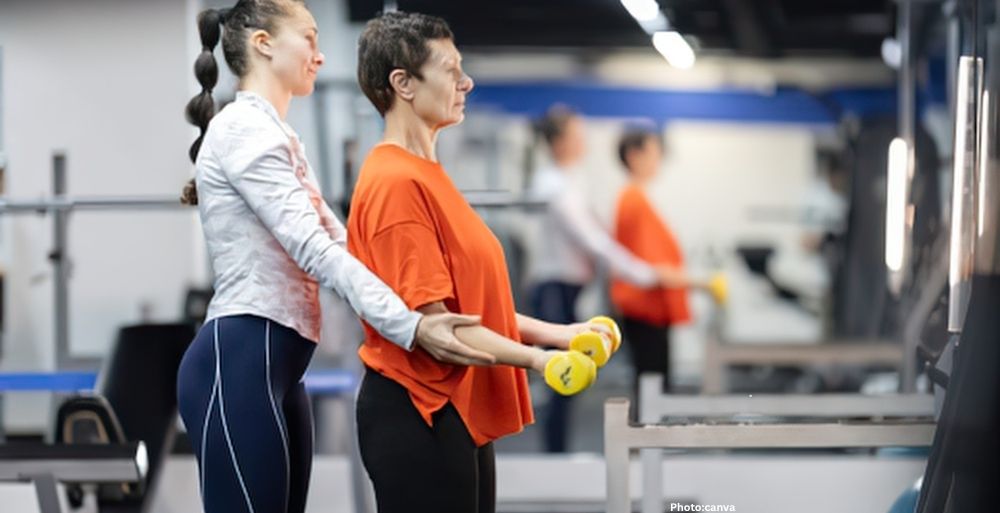
Gym machines isolate the muscles. For instance, when you perform leg presses, the machine does all the stabilizing for you. It supports your body weight, guides the path you’re taking, and keeps your spine stable.
“You’re loading a single muscle group in a single plane of motion. That builds force capacity but it does not build the small, deep, integrated stabilizing strength that gives the body the firm appearance most people are looking for,” Tateossian explains. “In comparison, free movement requires the entire neuromuscular system to participate. For example, a sit-to-stand or squat recruits the quads, glutes, core, foot stabilizers, and the small spinal extensors all at the same time, in the pattern your body actually uses to move through the world. This integrated firing is what visually shows up as muscle quality which is the difference between a body that looks structurally strong and one that looks soft.”
Below is a breakdown of the five daily movements Tateossian recommends to build functional, visible muscle quality.
1. Sit-to-Stands (Bodyweight Squats)
“Squats or sit-to-stands are the most predictive functional strength exercise after the age of 60. Squats load quads, glutes, and the core in the exact pattern that your body uses dozens of times per day, which is why daily exercise and practicing these daily translates into visible firmness in the thighs and glutes faster than a once a week leg press session in the gym,” Tateossian says.
How to Do It:
- Begin seated at the front of a sturdy chair, feet placed firmly under your knees.
- Lean forward just a bit from the hips.
- Try to stand up without using your knees, hands, or any additional support.
- Use control to slowly lower yourself back down into the seated position.
Prescription:
Perform 3 sets of 10 to 15 repetitions. Stick with a 3010 tempo:
- Take 1 second to stand up.
- Do not pause at the top.
- Lower yourself over 3 seconds.
- Do not pause once you are seated.
- Rest for 60 seconds between sets.
2. Wall Pushups
“Wall pushups are fantastic for all the muscles in your upper body such as your chest, triceps, your lats, and all the small stabilizing muscles around the shoulder blade that hold your posture together. Doing these daily is what brings back the ‘tone’ people are looking for in the chest and the back of the arms,” Tateossian notes.
How to Do It:
- Begin standing tall, roughly an arm’s-length away from a wall.
- Place your hands shoulder-width apart on the flat surface.
- Engage your core and bend your elbows to smoothly lower your chest toward the wall.
- Press back up to the starting position, keeping the movement slow and controlled.
Prescription:
Perform 3 sets of 10 to 12 repetitions, sticking with a 3010 tempo (3 seconds to lower toward the wall, 1 second to press away) and resting for 60 seconds between sets.
3. Hip Hinges with Overhead Reach
“This is the most underrated daily movement in this age category, but it is one of the best to practice daily. It loads the entire posterior chain—the glutes, the hamstrings, the lower back, and the mid back. These areas are part of the body that visibly declines with age and a sedentary pattern. Performing daily hip hinges restores the line from heel to neck and brings stability and strength,” Tateossian shares.
How to Do It:
- Stand tall with your feet hip-width apart and your arms relaxed at your sides.
- Press your hips backward while maintaining a tall, flat chest.
- At the same time, reach your arms straight overhead.
- As you hinge forward, feel a solid, active stretch in your hamstrings.
- Activate your hamstrings and glutes to drive your hips forward, returning to the start position.
Prescription:
Perform 3 sets of 10 to 15 repetitions, sticking with a 3010 tempo (3 seconds to hinge backward, 1 second to return to standing) and resting for 60 seconds between sets.
4. Countertop Heel Raises
“The calves shrink faster than almost any other muscle group after 60, and they’re the engine of every step that you take,” Tateossian points out. “Daily heel raises restore the lower leg shape that flattens out our 60s and, just as importantly, it helps with circulation and ankle stability.”
How to Do It:
- Begin standing tall with your feet hip-width apart, facing a kitchen counter or sturdy table.
- Lightly place your hands on the surface for balance.
- Slowly press through the balls of your feet to rise onto your toes as high as you are comfortably able to.
- Squeeze your calf muscles firmly at the top apex of the movement.
- Use deliberate control to lower your heels back to the floor.
Prescription:
Perform 3 sets of 20 repetitions, sticking with a 3010 tempo (3 seconds to lower the heels, 1 second to press upward) and resting for 60 seconds between sets.
5. Deadbugs
“This is a great exercise for the deep core and transverse abdominis—the muscles that wrap around the waist like a corset. When people say they want a tighter midsection, this is what they’re talking about. The key is to do them daily, do them slowly, with control and keep whole-body tension,” Tateossian says.
How to Do It:
- Lie face-up (on a mat, floor, or mattress) with your arms extended toward the sky and your knees lifted and bent at a 90° angle.
- Actively press your lower back down into the floor or mattress.
- Gradually lower your left arm backward over your head while simultaneously extending your right leg straight out.
- Return both limbs smoothly to the center starting position.
- Repeat the movement on the opposite side, lowering your right arm and left leg.
- Continue to alternate back and forth with control.
Prescription:
Perform 3 sets of 10 to 12 alternating repetitions. Move slowly to maintain full engagement of the abdominal wall throughout the exercise.


No Comment! Be the first one.