





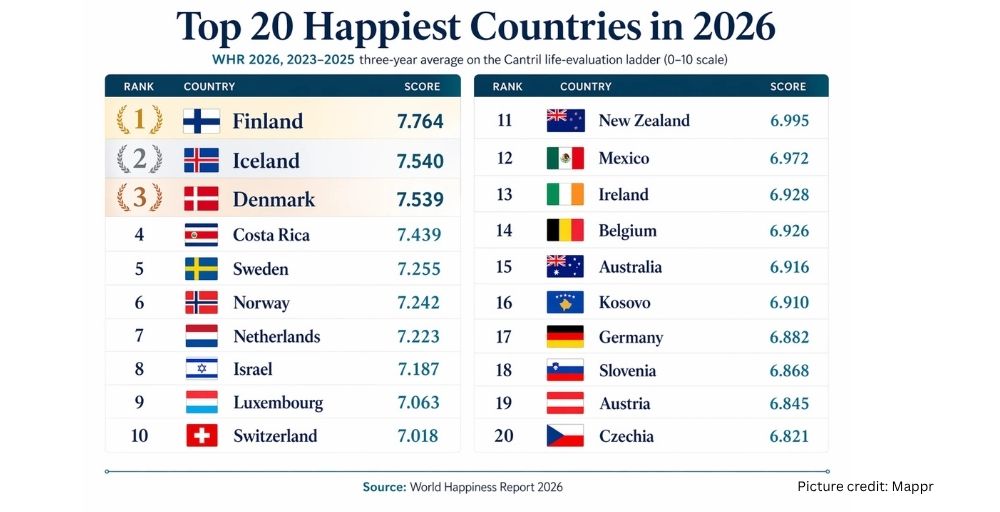
Finland remains the happiest country in the world, according to the latest World Happiness Report, with significant shifts in rankings and generational perspectives noted across the globe.
WASHINGTON, D.C. — Finland has been named the happiest country in the world for the ninth consecutive year, according to the 2023 World Happiness Report released on March 20, 2023. The report, which evaluates happiness across various nations based on life evaluations, continues to showcase the dominance of Nordic countries in the top ranks.
This year, Finland is joined at the top by Iceland, Denmark, Sweden, and Norway, occupying five of the top six positions. Notably, Costa Rica has made significant strides, ranking fourth and achieving the highest position ever for a Latin American country. The Netherlands, Israel, Luxembourg, and Switzerland complete the top ten list.
Methodology and Context
The World Happiness Report relies on data from the Gallup World Poll, which surveys individuals in over 140 countries. Respondents are asked to rate their life on a scale from zero, representing the worst possible life, to ten, the best possible life. The annual rankings are based on three-year averages, allowing for meaningful comparisons over time and across demographics.
The latest report reveals that while the top ranks remain populated by Western advanced economies, there is a growing recognition of countries outside this traditional grouping. Notably, the inclusion of Costa Rica and Israel signifies a shift in the geographic distribution of happiness rankings.
Shifts in Rankings
Since the inception of the World Happiness Report in 2013, which first utilized three-year averages, the composition of the top ten has evolved. In 2013, the list was entirely comprised of high-income Western nations. The current report, however, shows a slight diversification, with Costa Rica and Israel making notable appearances. Additionally, several long-standing high-income countries have seen declines in their rankings: Canada has dropped from sixth to 25th, Austria from eighth to 19th, and Australia from tenth to 15th.
Despite these fluctuations, the broader picture remains consistent, with fourteen Western advanced economies still appearing in the top 20 in both 2013 and the present report. The rankings reflect a long-term convergence in life evaluations, particularly between Eastern and Western European nations, with three countries from Central and Eastern Europe now included in the top 20: Kosovo at 16th, Slovenia at 18th, and the Czech Republic at 20th. The United States has notably declined from 17th to 23rd, a shift attributed largely to lower life evaluations reported by young adults.
Happiness Trends Globally
The report indicates that overall happiness has improved in more countries than it has declined when comparing current evaluations with a baseline from 2006 to 2010. Of the 136 countries ranked, 79 have experienced statistically significant increases in happiness, while 41 have reported declines. The largest improvements have been observed primarily in Central and Eastern Europe, reflecting a gradual convergence in life evaluations. Notable countries that have gained more than a full point since the baseline include Serbia, Bulgaria, Latvia, and Bosnia and Herzegovina.
Conversely, only eight countries have reported a decrease of more than one point in the last two decades, including Afghanistan, Malawi, Lebanon, Jordan, Venezuela, Botswana, Egypt, and Yemen. Many of these nations are grappling with significant instability or conflict, which continues to influence how residents assess their quality of life.
A Generational Perspective
The report highlights a generational divide in happiness, with young people in most countries reporting higher life evaluations today than they did two decades ago. Specifically, in 85 of the 136 countries analyzed, individuals under 25 indicate improved life satisfaction compared to the 2006-2010 period. This trend is particularly pronounced in several Central and Eastern European nations, including Serbia, Bulgaria, Latvia, Romania, and Lithuania.
However, the same positive trend is not evident in the NANZ countries—comprising the United States, Canada, Australia, and New Zealand—where youth happiness has decreased by an average of 0.86 points on the 0 to 10 scale. Outside of these countries, eight of the ten global regions, which encompass approximately 90% of the world’s population, are witnessing rising happiness scores among younger generations. The report attributes these changes to various factors, including the influence of social media and digital trends on the experiences of younger individuals.
Implications for Policy and Leadership
The findings of the 2023 World Happiness Report underscore the evolving landscape of global happiness and the importance of understanding both the rankings and the underlying changes in life evaluations. Leaders who take these insights into account may be better positioned to develop policies that enhance wellbeing across different generations and geographical regions.
The report is a collaborative effort among Gallup, Oxford’s Wellbeing Research Centre, the U.N. Sustainable Development Solutions Network, and the WHR’s Editorial Board. For detailed methodology and survey specifics, readers can refer to Gallup’s Country Data Set.






No Comment! Be the first one.