





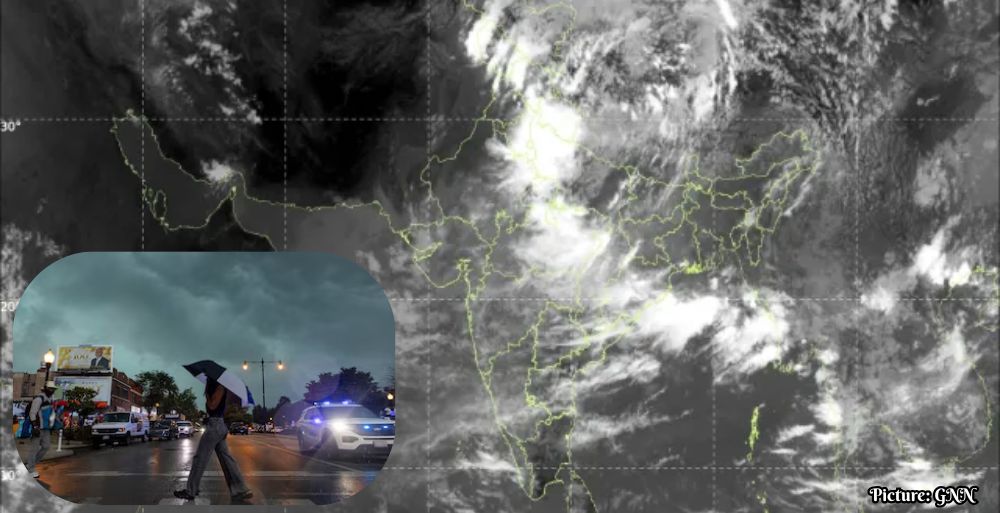
El Niño conditions are intensifying, with the National Oceanic and Atmospheric Administration forecasting a potentially historic event that could significantly influence global weather patterns, hurricane activity, and temperatures.
The National Oceanic and Atmospheric Administration (NOAA) has issued a forecast indicating that the El Niño phenomenon is gaining strength and is likely to result in one of the most significant events recorded since 1950. According to NOAA, the current El Niño is classified as the second strongest for this time of the year, trailing only the conditions observed in 1997. The agency has stated that there is a 69% chance of experiencing a historic El Niño event that will exceed the intensity of any previous occurrences.
Michelle L’Heureux, a physical scientist at NOAA’s Climate Prediction Center, conveyed this heightened confidence, stating, “Our team has become more confident in the possibility of a very strong El Niño by the end of this year. There is a greater than 90% chance of a ‘very strong’ El Niño, which is the highest chance to date, and expresses our confidence in the growth and development of a potentially historic El Niño event.” This forecast has critical implications for weather patterns, hurricane seasons, and global temperatures.
Understanding El Niño
El Niño is characterized by warmer-than-average sea surface temperatures in the central and eastern equatorial Pacific Ocean. This phenomenon is part of a larger cycle known as the El Niño-Southern Oscillation (ENSO), which includes La Niña, the cooler phase, and ENSO-neutral conditions. NOAA evaluates the strength of El Niño events by measuring sea surface temperature anomalies, categorizing them as weak, moderate, strong, or very strong. While terms like “super” and “extreme” are often used in popular discourse, NOAA and the World Meteorological Organization (WMO) adhere to a standardized classification system.
Projected Impacts Across the United States
The impacts of El Niño typically manifest most strongly from late autumn through early spring, following the onset of the event. However, experts caution that weather patterns can vary significantly from year to year, with notable exceptions. L’Heureux emphasized this uncertainty, stating, “The data is very clear that we can be more confident in certain impacts occurring during strong and very strong El Niño, but it is really important to emphasize that even if this ends up being a historic El Niño, there will be impacts in some locations that do not align with the expected El Niño impact. This is why our seasonal forecasts are expressed in terms of probabilities.”
The anticipated effects of this El Niño event across various regions of the United States include:
Northeast
In the Northeast, El Niño typically favors warmer-than-average temperatures during winter. While the influence is less pronounced compared to the Upper Midwest and Northwest, there is an increased probability of above-average snowfall in the mid-Atlantic and coastal areas, as coastal storms are expected to be more frequent. However, areas further inland may experience drier conditions.
South
Across the southern U.S., temperatures are projected to be near to below average, particularly from Texas to the Southeast. Precipitation patterns suggest wetter-than-average conditions across the Gulf Coast and Southeast, while parts of the south-central Mississippi Valley may see below-average rainfall.
Midwest
In the Midwest, particularly from the northern Plains to the Great Lakes, warmer-than-average temperatures are anticipated. Drier-than-average conditions may prevail in the Ohio Valley and Great Lakes regions, although above-average snowfall is expected in the south-central Plains.
West
The West Coast is likely to experience warmer-than-average temperatures during winter, with wetter-than-average conditions predicted across southern California and much of the Southwest. However, parts of the northern Rockies may see below-average precipitation.
Alaska
Impacts in Alaska are expected to be more pronounced, with warmer and drier conditions likely during winter and spring. This could lead to reduced snowfall and a decreased snowpack, with precipitation trends closer to average.
Hawaii
In Hawaii, rainfall is generally above average during the year an El Niño develops, transitioning to drier conditions in the following winter, which raises the risk of drought and wildfires.
El Niño’s Influence on Hurricane Activity
El Niño plays a critical role in shaping hurricane activity. Current forecasts indicate that the upcoming hurricane season will be significantly influenced by the evolving El Niño conditions. Typically, El Niño suppresses tropical activity during the Atlantic hurricane season due to unfavorable atmospheric winds, while conditions in the Eastern Pacific favor an increase in hurricane activity.
Global Temperature Implications
Historically, El Niño years have been associated with record-high global temperatures. NOAA reports that 2024 was the warmest year on record, following the previous El Niño event. The anticipated strong El Niño could challenge global temperature records once again, especially considering the ongoing trend of climate change driven by human-induced greenhouse gas emissions. Jon Gottschalck, chief of the Operational Prediction Branch at NOAA, noted, “Warmer ocean temperatures associated with El Niño, together with its tendency to favor warmer conditions in many areas, often contribute to warmer than normal global annual temperatures.”
NOAA’s outlook suggests that 2026 is virtually certain to be one of the five warmest years recorded, with a 99.9% probability. However, the likelihood of it becoming the warmest year stands at less than 1%, although forecasts indicate that odds will likely increase for 2027.
In conclusion, the evolving El Niño presents a complex landscape of potential impacts on weather patterns, hurricane activity, and global temperatures, warranting close monitoring and continued research as the phenomenon develops over the coming months.






No Comment! Be the first one.