




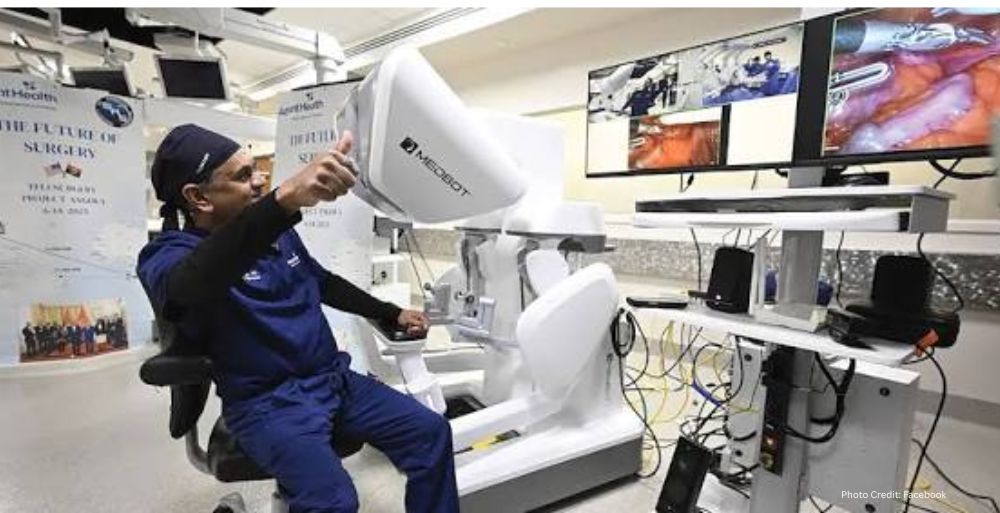
A Florida surgeon has performed the first telerobotic operation between two U.S. hospitals, marking a significant advancement in remote surgical techniques.
In a notable advancement for remote surgical procedures, Dr. Vipul Patel, the founder and medical director of the Global Robotics Institute at AdventHealth Celebration in Orlando, Florida, successfully conducted the first telerobotic prostatectomy between two hospitals in the United States on Sunday. The patient, a 66-year-old man named Mark, was treated for prostate cancer while located at an AdventHealth facility in Minneola, approximately 35 miles away from Dr. Patel’s operational base in Celebration. This surgical procedure represents a significant milestone in the field of telesurgery, which allows for remote surgical interventions using robotic systems.
This innovative surgery is part of a clinical research study evaluating a robotic telesurgery system that has received authorization from the Food and Drug Administration (FDA) under an investigational device exemption. This exemption allows for the evaluation of the system’s efficacy but does not equate to full FDA approval or clearance for general surgical use.
Context and Implications of Telesurgery
Dr. Patel’s operation is the culmination of prior investigational telesurgeries, having previously been conducted between Orlando, Florida, and Luanda, Angola. The recent operation signifies the study’s expansion into U.S. hospitals, a move that could reshape the landscape of healthcare delivery. “For generations, access to highly specialized care has often depended on where a patient lives,” Dr. Patel stated in an AdventHealth news release. He further emphasized that this study aims to evaluate whether telesurgery could one day help eliminate the geographic barriers that limit access to specialized medical treatment.
The concept of telesurgery, which enables surgeons to control robotic instruments from a distance, holds the potential to revolutionize patient care, especially in rural or underserved areas where specialized surgical services may be scarce. However, the technology remains under rigorous evaluation concerning its safety, reliability, and cybersecurity risks. AdventHealth has clarified that the recent surgery does not provide definitive evidence regarding the overall clinical performance of the telesurgery system.
Risks and Challenges of Robotic Surgery
While robotic prostatectomy offers advantages such as precision and minimally invasive techniques, it also carries inherent risks. These include complications such as bleeding, infection, incontinence, and erectile dysfunction. Moreover, there is a possibility that the procedure may need to be converted to open surgery if significant complications arise. Telesurgery introduces additional layers of risks, including the potential for equipment malfunctions, connection failures, and cybersecurity threats. As a precaution, an on-site medical team is essential to intervene if any complications occur during the procedure.
Recent Innovations in Surgical Technology
The telerobotic procedure performed by Dr. Patel follows another significant achievement in the realm of remote surgery, which occurred just months prior. A surgeon in London successfully operated on a patient located 1,500 miles away in Gibraltar using an advanced four-armed robot equipped with a 3D camera. That operation was remarkable for its exceptionally low lag time of merely 0.06 seconds between the surgeon’s commands and the robot’s responses. Such advancements highlight the rapid evolution of surgical technology and its capability to facilitate surgeries across vast distances.
The implications for healthcare access are profound, as the ability to conduct surgeries remotely could enable patients in remote or underserved areas to receive specialized medical care that would otherwise be unattainable. Telesurgery has the potential to redefine surgical practices and improve patient outcomes across various demographics, particularly in regions where access to skilled surgeons is limited.
Patient Recovery and Future Considerations
Mark, the patient who underwent this landmark telerobotic surgery, is reportedly recovering well, according to AdventHealth. His positive recovery could provide critical data points in evaluating the effectiveness and viability of the telerobotic system in real-world scenarios. The success of this procedure may catalyze further investments and research into the field of telesurgery, potentially leading to broader acceptance and implementation within the medical community.
As the field of telesurgery continues to develop, ongoing research, patient safety, and regulatory oversight will be essential in determining its future applications. Balancing the benefits of innovative surgical technologies with ensuring patient safety is paramount as healthcare providers navigate the complexities of implementing these advanced medical techniques.
As this technology progresses, stakeholders must remain vigilant regarding its ethical implications, ensuring that patient care remains the priority throughout its development. The potential for telesurgery to bridge gaps in healthcare access will be a focal point for ongoing research and clinical evaluation in the coming years, as the medical community seeks to harness the advantages of remote surgical techniques while addressing the associated risks and challenges.



No Comment! Be the first one.