






Despite the ongoing challenges faced by Afghan women, cricketers like Benafsha Hashimi remain determined to gain international recognition and play alongside their global counterparts.
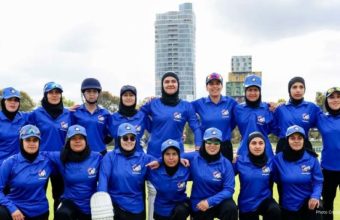
In a poignant reflection of resilience, Afghan cricketer Benafsha Hashimi and her teammates continue to pursue their dreams of playing cricket at the international level, even as the Taliban’s return to power in 2021 has severely restricted women’s rights in Afghanistan. Hashimi, who was contracted by the Afghanistan Cricket Board just before the Taliban takeover, fled to Australia at the age of 18, where she and many of her teammates formed a team in exile. Last year, they marked a significant milestone by playing their first match in Melbourne.
Recently, Hashimi and her fellow cricketers celebrated a notable achievement for Afghan athletes when FIFA approved the Afghanistan women’s football team to compete internationally. Hashimi expressed her joy at this development, stating, “Finally, one of the girls’ teams did it because both of us, football and cricket, have been fighting since we came to Australia.” This achievement comes after the football team, which fled the country alongside the cricketers, had been playing under the title ‘Afghan Women United’ for a year due to a lack of recognition from FIFA.
In April, FIFA amended its governance regulations, allowing the displaced players to compete without the approval of the Afghanistan Football Federation. This change has enabled the football team to strategize for international competitions, including the World Cup. Midfielder Nazia Ali noted, “For the last few years, we have played under many names as refugees – but in our hearts, we were always the national team.”
Cricket Aspirations Amidst Uncertainty
Following the football team’s recognition, Hashimi and her teammates are now calling for the International Cricket Council (ICC) to adopt a similar approach. Hashimi stated, “We were so happy [for the footballers], and then later on we made some [social media] videos to congratulate them and tell the ICC that FIFA and ICC, they both are the same as each other. When [FIFA] can do it, why can’t the ICC?” She emphasized their desire for recognition and the opportunity to compete like other national teams.
Despite the ICC’s limited engagement with Afghan players, the Afghanistan Cricket Board maintains full membership status, despite the absence of a women’s team. Last April, the ICC introduced a fund aimed at supporting the players with advanced coaching, access to world-class facilities, and personalized mentorship, facilitated by cricket boards from England, India, and Australia. This initiative allowed the Afghan women’s team to travel to India during the Women’s World Cup, where they played friendly matches and received coaching.
Hashimi described the experience of meeting renowned players like Harmanpreet Kaur and Jemimah Rodrigues as surreal, saying, “Watching your idols, it’s something different, you will be speechless or wordless. We were over the moon.” Looking ahead, the team is set to travel to England for another tour and attend the Women’s T20 World Cup final at Lord’s, where they continue to be recognized as the “Afghanistan Refugee Women’s Team.”
The Quest for Official Recognition
As the cricketers continue their training, Hashimi expressed concern over the future of their ICC support. “We are practicing [more] consistently than before. But there is no idea what we will do when it finishes. After August I don’t think we have anything,” she remarked, highlighting the uncertainty surrounding their prospects. The ICC has not publicly commented on the status of the team.
Hashimi articulated the significance of official recognition for her and her teammates. “It would be really great, honestly. I will achieve what I was fighting for since I was back home,” she said. Her journey to becoming a cricketer was fraught with challenges, as she faced societal expectations that limited women’s roles to domestic responsibilities. “Whenever I was asking my mother, she was telling me: ‘Women just do homework, washing dishes, making babies, and taking care of babies.’ I was really hopeless at that time,” she recalled.
After persevering for nearly a decade, Hashimi finally secured a contract with the Afghanistan Cricket Board, only to have the Taliban’s return disrupt her aspirations. “Look how unlucky I am,” she said with a bittersweet laugh.
A Focus on the Future
Currently, Hashimi is dedicated to honing her skills as a cricketer, focusing on her transition from leg-spin bowling to wicketkeeping. She aspires to study sports management, science, and psychology, but her primary ambition remains clear: “I want to be a cricketer.” Her dreams, along with those of her teammates, depend heavily on the decisions of cricket’s governing bodies.




No Comment! Be the first one.