





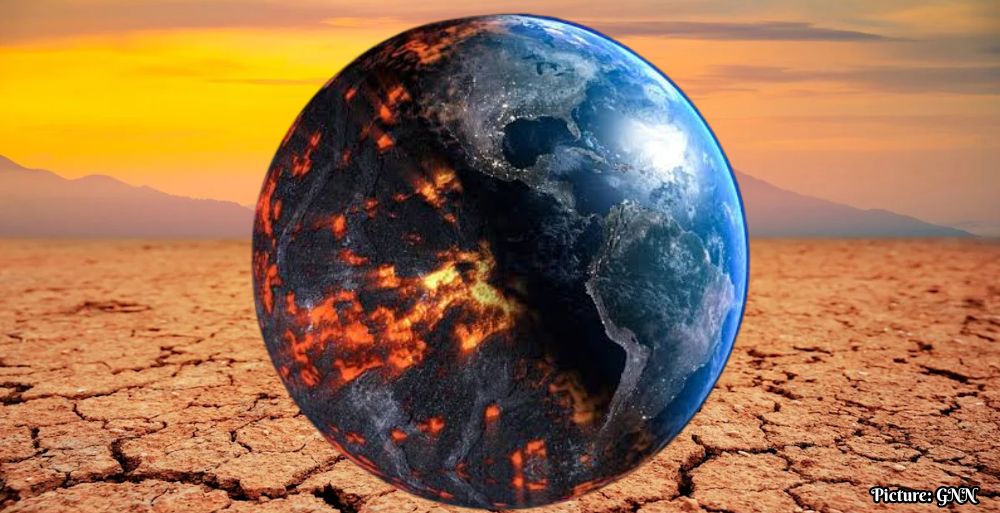
This article explores a new study that predicts significant changes in Earth’s ability to support life as the Sun’s luminosity increases, potentially leading to the extinction of plant life in approximately 1.8 billion years.
In a groundbreaking study published in the journal JGR Atmospheres, researchers have provided new insights into the future of life on Earth, predicting that plant life may be unable to sustain itself beyond 1.8 billion years due to the Sun’s increasing luminosity. This finding stands in stark contrast to earlier estimates, which suggested that significant plant extinction could occur much sooner.
The Sun, currently classified as a G-type main-sequence yellow dwarf star, undergoes gradual changes as it ages. Over the course of approximately 10 billion years, the Sun will exhaust its hydrogen reserves and transition into a Red Giant, a process that is expected to culminate in the engulfment of Earth. However, the researchers emphasize that the increasing brightness of the Sun will pose a more immediate threat to life on our planet long before this cataclysmic event unfolds.
As the Sun continues to burn hydrogen, its luminosity increases by about 1 percent every 110 million years. Currently, the Sun’s output is approximately one-third greater than it was at the formation of the Solar System. This gradual increase in energy output will pose significant challenges for sustaining life on Earth.
Impacts on the Biosphere
The study’s authors assert, “The ultimate lifespan of Earth’s biosphere is limited due to the steady brightening of the sun as it progresses in age.” They explain that the long-term carbon cycle on Earth may respond to the Sun’s increasing luminosity by drawing carbon dioxide from the atmosphere into carbonate rocks. This process could diminish the greenhouse effect and further jeopardize plant life, a vital component of the biosphere.
Previous studies had suggested that the depletion of carbon dioxide levels in the atmosphere would lead to the extinction of larger organisms, including plants that depend on CO2 for photosynthesis. Initial calculations indicated that plant life could face extinction as soon as 100 million years from now. However, subsequent revisions that considered different photosynthesis processes adjusted this timeline to as much as 1.5 billion years.
Approximately 95 percent of plant species on Earth utilize C3 photosynthesis, which requires CO2 concentrations of around 150 parts per million. Conversely, C4 photosynthesis plants, such as corn and grasses, can survive with only 15 parts per million of CO2. The most resilient are those employing crassulacean acid metabolism (CAM) photosynthesis, like cacti and orchids, which can thrive even at CO2 levels as low as 1 part per million.
Modeling Future Scenarios
In their research, the study team developed 29 climate models to simulate various scenarios that could impact the Earth’s vegetative biosphere. The models primarily focused on two parameters: carbon dioxide levels and temperature. Among the most extreme scenarios were those portraying an Earth too hot for life to survive.
In the weak-weathering scenario, wherein CO2 levels remain stable, plants utilizing CAM photosynthesis are projected to survive until roughly 1.87 billion years from now. In contrast, the strong-weathering scenario, which assumes insufficient CO2 to support life, predicts that plant life may cease to exist around 1.35 billion years into the future. However, even under the strong-weathering model, the survivability timeframe extends to approximately 1.84 billion years when considering plants that utilize CAM photosynthesis.
The authors of the study caution that these predictions coincide with the anticipated loss of Earth’s oceans to space, a consequence of the Sun’s increased luminosity. Notably, the researchers point out that their models assess photosynthesis as it currently operates, without accounting for potential future evolutionary adaptations.
Future Research Directions
In their concluding remarks, the authors recognize the resilience of life on Earth, suggesting that current limitations imposed by thermal stress or nutrient scarcity may not represent absolute thresholds for future biospheric evolution. They state, “We acknowledge that the results of this study should be examined with other 3-D models, and that a community effort that compares model results at high insolation and low would be the best way to constrain these timescales.” This indicates a call for further research and collaboration within the scientific community to refine our understanding of Earth’s future.
The research underscores the ongoing challenges posed by climate change and the necessity for continued study into how life may adapt in the face of such profound planetary transformations over geological time scales. As humanity looks to the future, understanding these dynamics will be crucial for both ecological preservation and long-term planning.






No Comment! Be the first one.