





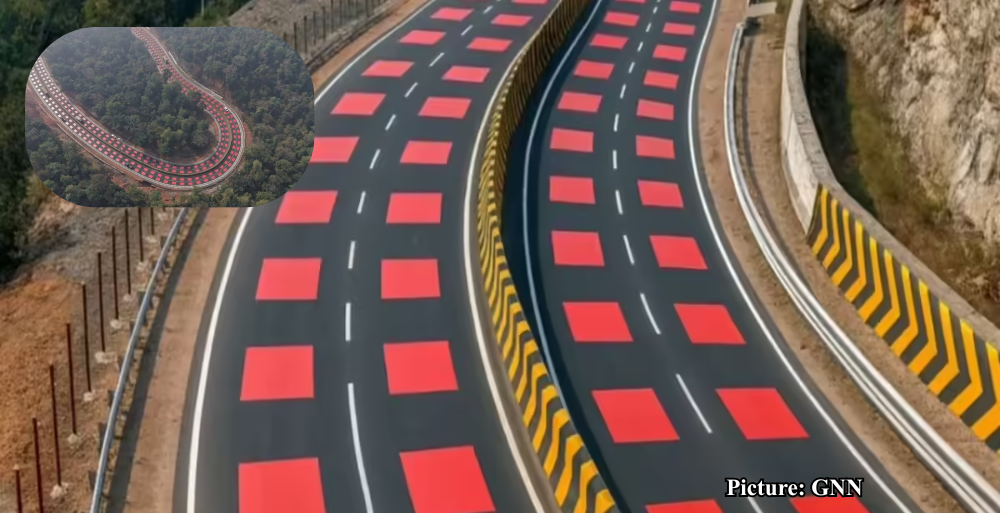
India has inaugurated its first ‘red road’ on National Highway 45 in Madhya Pradesh, introducing innovative design features aimed at protecting wildlife and reducing vehicle speeds without traditional enforcement methods.
India has officially launched its first “red road” initiative on National Highway 45 in Madhya Pradesh, a project designed to mitigate wildlife-vehicle collisions while enhancing road safety for drivers. The initiative, implemented by the National Highways Authority of India (NHAI) under the Ministry of Road Transport and Highways, represents a significant step towards integrating wildlife conservation with infrastructure development.
Project Overview
The red road project spans 11.96 kilometers (approximately 7.4 miles) through the Veerangana Durgavati Tiger Reserve, an area known for its rich biodiversity. Central to this initiative is a 5-millimeter (about 0.2-inch) hot-applied thermoplastic red surface layer that has been applied over a 2.0-kilometer (approximately 1.2-mile) danger zone identified as high-risk for animal crossings. The bright red color is designed to attract drivers’ attention and the texture of the surface is engineered to induce a tactile response, encouraging drivers to reduce their speed without the need for sudden braking.
Enhancements for Wildlife Protection
To further address the risks posed by wildlife on the road, NHAI has incorporated several key features along this stretch of highway. The project includes 25 dedicated animal underpasses, strategically located at points identified as common movement areas for wildlife. These underpasses are crucial for providing safe passage for animals, effectively reducing the likelihood of collisions. Additionally, continuous chain-link fencing flanks both sides of the highway, designed to deter animals from entering the roadway while guiding them towards these safe crossing points.
The infrastructure also includes monitoring technology, such as cameras on minor bridges that can serve as crossing points, alongside solar lighting installed at critical junctions. These enhancements aim to improve visibility and monitoring capabilities without imposing significant environmental burdens.
Context and Research on Wildlife Collisions
Wildlife-vehicle collisions present a serious challenge globally, with the United States alone estimating one to two million such incidents annually involving large animals. These collisions not only pose a substantial safety risk to drivers but also result in significant wildlife mortality. Research indicates that effective wildlife management strategies must incorporate both physical barriers and designated crossing spaces. A comprehensive meta-analysis has shown that fencing combined with crossing structures can reduce roadkill by approximately 83%, while fencing alone can decrease roadkill by about 54%. This underscores the importance of a multifaceted approach to wildlife conservation in conjunction with road safety.
Psychological Aspects of Road Design
NHAI’s approach to road safety leverages principles of behavioral psychology, utilizing design elements that subtly encourage drivers to modify their behavior. The raised red surfacing provides mild tactile feedback and auditory cues, prompting drivers to lower their speeds in a way that feels instinctive rather than enforced. This design strategy seeks to create a safer driving environment without relying on traditional traffic enforcement methods, such as speed traps, which can lead to driver frustration and non-compliance.
International Comparisons and Future Developments
The initiative in India aligns with a broader global trend towards developing wildlife-friendly infrastructure. For instance, in February 2026, Chile’s Ministry of Public Works announced plans to upgrade Route 5, which will include seven wildlife crossings designed to enhance ecological safety. This substantial project, with an investment of $594 million, aims to address similar challenges faced by wildlife in the region. Construction is slated to commence in 2028, with full operational capacity anticipated by 2033, illustrating a long-term commitment to integrating ecological considerations into transportation planning.
Monitoring and Future Implications
The success of India’s “red road” initiative will rely heavily on ongoing monitoring and evaluation. Key performance indicators will include speed data through the marked zones, wildlife collision statistics collected before and after the implementation of the project, and evidence indicating that animals are effectively utilizing the designated underpasses. Additionally, maintaining the integrity of the fencing and underpasses will be critical; any breaks in the fencing or blockages in the underpasses could undermine the project’s intended benefits.
Ultimately, the “red road” initiative aspires to reshape the interaction between transportation networks and wildlife habitats, striving to reduce the lethality of roadways for animals while acknowledging the practical realities of modern infrastructure development. This project not only aims to enhance safety for drivers but also endeavors to foster a more harmonious coexistence between human activities and the natural environment.





No Comment! Be the first one.