







A decades-long geological dispute has been settled as new seismic imaging and mineral analysis confirm the Silverpit Crater was formed by a 160-meter asteroid. The impact, which occurred approximately 45 million years ago, triggered a catastrophic 330-foot tsunami and provides a rare, preserved look at marine cratering dynamics.
The floor of the North Sea, long a theater for the industrial extraction of oil and gas, has officially been confirmed as the site of a prehistoric violent upheaval. For over twenty years, geologists have bickered over the origins of the Silverpit Crater, a complex subterranean structure located roughly 80 miles off the coast of Yorkshire. Today, an international team of researchers has provided the “smoking gun” evidence required to classify the site as a hypervelocity impact crater, ending one of the most persistent debates in modern marine geology.
The discovery, led by Dr. Uisdean Nicholson of Heriot-Watt University and published in the journal Nature Communications, reveals that approximately 43 to 46 million years ago, an asteroid roughly the size of a modern football stadium slammed into the shallow seas of the Eocene epoch. The resulting explosion didn’t just scar the earth; it displaced an unimaginable volume of water, sending a 330-foot tsunami racing toward prehistoric coastlines and lofting a 1.5-kilometer-high curtain of debris into the atmosphere.
From Skepticism to Certainty
Since its discovery in 2002 by petroleum geologists Simon Stewart and Philip Allen, Silverpit has been a source of professional friction. The feature consists of a three-kilometer-wide inner crater surrounded by a series of concentric, ring-like faults stretching across a 20-kilometer diameter. While the symmetrical nature of the rings screamed “asteroid strike” to some, others remained unconvinced.
Throughout the mid-2000s, alternative theories gained significant traction. Some researchers argued the structure was the result of salt withdrawal—a process where subterranean salt deposits dissolve or migrate, causing the overlying rock to collapse in a circular pattern. Others pointed toward volcanic collapse. The skepticism was so entrenched that during a 2009 formal debate hosted by the Geological Society of London, a majority of attending scientists actually voted against the impact hypothesis.
“It is incredibly rewarding to have finally found the silver bullet,” said Professor Gareth Collins of Imperial College London, who provided numerical simulations for the study and was present at that 2009 debate. “I always thought the impact hypothesis was the simplest explanation and most consistent with the observations.”
The turning point came through a combination of high-resolution 3D seismic imaging—technology typically used by the energy sector to locate carbon reserves—and the physical recovery of rare minerals from an exploratory oil well.
The Microscopic Proof
The definitive evidence lay in the crystalline structure of the rocks themselves. Dr. Nicholson’s team identified “shocked” quartz and feldspar crystals within samples pulled from the crater floor. These minerals do not form under normal volcanic or tectonic conditions; they require the instantaneous, extreme pressures—measured in gigapascals—that only a hypervelocity impact can generate.
“We were exceptionally lucky to find these—a real ‘needle-in-a-haystack’ effort,” Dr. Nicholson noted. These microscopic deformations serve as a permanent geological record of the moment the asteroid’s kinetic energy was converted into heat and pressure. The presence of these minerals effectively nullifies the salt-collapse and volcanic theories, anchoring Silverpit alongside the world’s most famous impact sites, such as the Chicxulub Crater in Mexico, which famously ended the reign of the dinosaurs.
A Cataclysm in the North Sea
Using computer modeling, the researchers reconstructed the event with chilling detail. The asteroid, estimated at 160 meters in diameter, likely approached from the west at a shallow angle. When it struck the seabed, which was then covered by a relatively shallow sea, the energy release was equivalent to several thousand megatons of TNT.
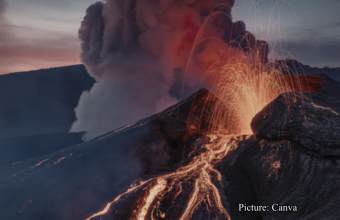
The immediate aftermath was a vertical “ejection curtain” of pulverized rock and seawater that reached heights of nearly a mile. As this column collapsed back into the ocean, it generated a tsunami exceeding 100 meters in height. For context, this is more than double the height of the waves seen in the 2004 Indian Ocean disaster. Such a wave would have decimated regional coastlines, altering the sedimentary landscape of what is now Western Europe.
Broader Implications for Planetary Science
The confirmation of Silverpit is more than just a win for historical record-keeping; it provides a rare laboratory for understanding marine impacts. While Earth has roughly 200 confirmed impact craters, the vast majority are on land. Only about 33 have been identified beneath the ocean, where they are often buried by millions of years of sediment or destroyed by plate tectonics.
Because Silverpit was quickly buried by seafloor sediments, it has been shielded from the erosion that typically scrubs such features from the Earth’s surface. This preservation allows scientists to study the “ring” mechanics of impact craters in a way that is difficult to replicate on other planets like Mars or the Moon, where we lack high-resolution subsurface data.
Furthermore, the discovery adds to a growing body of evidence regarding the frequency of mid-sized asteroid strikes. While the “planet-killers” like Chicxulub are rare, 160-meter objects strike with much higher frequency on a geological timescale. Understanding the Silverpit event helps modern planetary defense experts model the potential risks and environmental consequences should a similar object enter Earth’s trajectory today.
“We can use these findings to understand how asteroid impacts shaped our planet throughout history, as well as predict what could happen should we have an asteroid collision in the future,” Dr. Nicholson said. For now, the North Sea has yielded a secret 45 million years in the making, transforming a contested geological anomaly into a definitive monument to Earth’s violent cosmic history.




No Comment! Be the first one.