





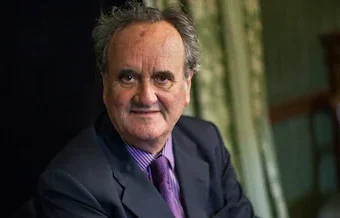
Sir Mark Tully, the legendary broadcaster, author, and longtime BBC correspondent widely regarded as the “voice of India”, has passed away at the age of 90, leaving behind an extraordinary legacy of journalism that shaped how millions across the world understood India.
Table Of Content
- Witness to History — And Danger
- A British Journalist with an Indian Soul
- From Theology to Journalism
- Reporting Beyond Headlines: Giving Voice to Ordinary Indians
- Expelled, Then Welcomed Back
- A Journalist with Principles — Even When It Cost Him
- Honors from Both India and Britain
- A Life of Writing, Reflection, and Quiet Living
- A Lasting Legacy
For decades, Sir Mark’s rich, warm voice and thoughtful storytelling brought India’s political, social, and cultural realities into homes in Britain and beyond. Known for his deep empathy, sharp insights, and unwavering commitment to truth, he chronicled some of the most defining moments in modern South Asian history — from wars and assassinations to religious conflict, natural disasters, and political upheaval.
Among the events he reported on were the Bhopal gas tragedy, the storming of the Golden Temple, communal riots, famine, and seismic political transitions that reshaped India and its neighbors.
“Sir Mark opened India to the world through his reporting, bringing the vibrancy and diversity of the country to global audiences,” said Jonathan Munro, Interim CEO of BBC News and Current Affairs.
“Widely respected in both India and the UK, he was a joy to speak with and will be greatly missed.”
Witness to History — And Danger
One of the most perilous moments in Sir Mark’s career came in Ayodhya in 1992, when he witnessed the demolition of the Babri Masjid, an event that triggered some of the worst communal violence in independent India.
As Hindu hardliners tore down the mosque, Tully found himself trapped amid an enraged crowd suspicious of foreign media.
“Death to Mark Tully,” members of the mob reportedly chanted.
He was locked inside a room for several hours before being rescued by a local official and a Hindu priest. Years later, Sir Mark described the mosque’s destruction as “the gravest setback to secularism since India’s independence in 1947.”
A British Journalist with an Indian Soul
Born in 1935 in Calcutta (now Kolkata) during the British Raj, Sir Mark Tully grew up in a family deeply connected to India. Though British by nationality, India was always more than a posting — it was his home.
His mother was born in Bengal, and his family had lived in India for generations. Despite being raised in a colonial environment, he developed a deep emotional connection to Indian society, culture, and language.
He later became fluent in Hindi, a rare accomplishment among foreign correspondents in Delhi, earning him widespread respect and the affectionate title “Tully sahib.”
“It’s really important to treasure the secular culture of this country, allowing every religion to flourish,” he told an Indian newspaper in 2016.
“…We must not endanger this by insisting on Hindu majoritarianism.”
His love for India earned him friendships with politicians, editors, intellectuals, and grassroots activists, who admired both his insight and sincerity.
From Theology to Journalism
After World War II, Sir Mark moved to Britain for his education at age nine. He studied history and theology at Cambridge, and at one point even considered becoming a clergyman — a reflection of his lifelong engagement with faith and spirituality.
However, his path eventually led to journalism. He joined the BBC in 1965, initially in an administrative role before transitioning into reporting — a move that would define his legacy.
His broadcasting style was described as distinctive, reflective, and quietly authoritative, with an emphasis on context, nuance, and human voices rather than sensationalism.
Reporting Beyond Headlines: Giving Voice to Ordinary Indians
Sir Mark was never content being an armchair correspondent. He travelled extensively across India and South Asia, often by train, reporting not just on elites but on ordinary citizens — farmers, laborers, villagers, activists, and everyday families.
He covered the birth of Bangladesh, military rule in Pakistan, the Sri Lankan civil conflict, and the Soviet invasion of Afghanistan, spending more than 20 years as the BBC’s bureau chief in Delhi.
Comfortable in both a kurta and a suit, he embodied a rare cultural bridge — neither fully outsider nor insider, but deeply rooted in the region he reported on.
Expelled, Then Welcomed Back
In 1975, during Indira Gandhi’s Emergency, Sir Mark was expelled from India with just 24 hours’ notice. But he returned 18 months later, resuming his reporting and reaffirming his enduring bond with the country.
“India is where I feel I belong,” he once said — a sentiment reflected in the fact that he spent three-quarters of his life living there.
A Journalist with Principles — Even When It Cost Him
In the early 1990s, Sir Mark found himself increasingly at odds with the BBC’s corporate leadership. In 1993, he delivered a now-famous speech accusing then Director General John Birt of running the BBC through “fear.”
The fallout led to his resignation in 1994, marking the end of his official tenure — but not his public voice.
He continued broadcasting, notably hosting BBC Radio 4’s Something Understood, returning to themes of faith, meaning, and moral reflection that had shaped his early life.
Honors from Both India and Britain
Sir Mark received rare recognition from both nations he considered home.
India awarded him two of its highest civilian honors:
- Padma Shri
- Padma Bhushan
Britain knighted him in 2002 for his services to broadcasting and journalism.
He humbly described the knighthood as:
“An honour to India.”
Later in life, he became an Overseas Citizen of India, calling it:
“A recognition of the two countries I feel I belong to — India and Britain.”
A Life of Writing, Reflection, and Quiet Living
Beyond broadcasting, Sir Mark authored numerous books on India, including essays, political commentary, cultural reflections, and short stories — often collaborating with his partner Gillian Wright.
Despite his fame, he lived modestly in south Delhi, preferring intellectual conversation and observation over public spectacle.
His work remains a benchmark for foreign correspondence, admired for its depth, fairness, cultural sensitivity, and moral clarity.
A Lasting Legacy
Sir Mark Tully’s death marks the end of an era — not just for the BBC, but for global journalism.
He was a reporter who listened deeply, a storyteller who honored complexity, and a bridge between India and the world. At a time when fast news often replaces thoughtful reporting, his life stands as a reminder of journalism’s highest ideals: truth, empathy, patience, and integrity.
“He gave voice to the hopes and fears of ordinary Indians as well as the country’s elite,” colleagues recalled.
“His journalism helped the world understand India — not as a headline, but as a living, breathing civilization.”
Sir Mark Tully leaves behind a legacy that will continue to inspire generations of journalists — and millions who came to understand India through his words.




No Comment! Be the first one.