





Public health experts raise concerns about President Trump’s executive order aiming to separate combination vaccines, including the MMR shot, into individual injections, citing potential health risks and logistical challenges.
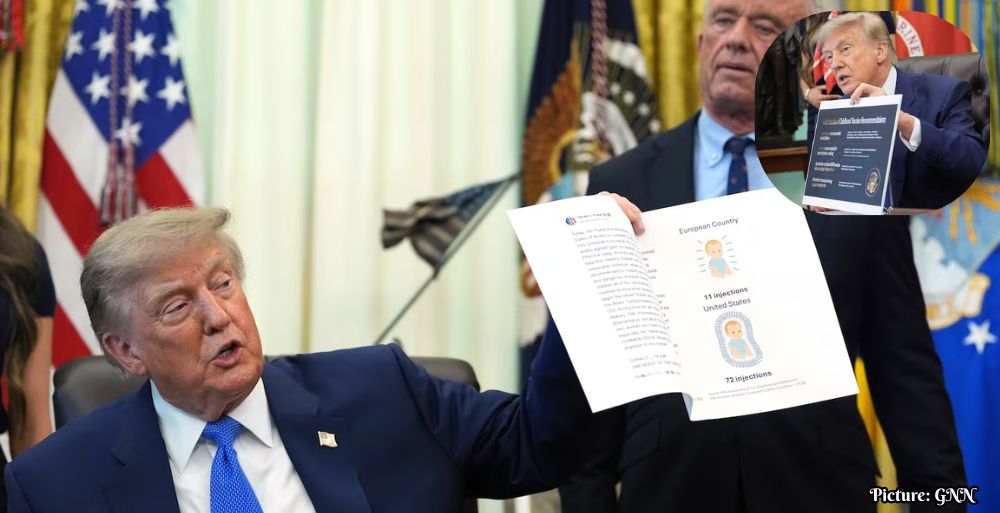
WASHINGTON — On Monday, President Donald Trump announced an executive order that calls for the separation of combination vaccines, specifically the measles, mumps, and rubella (MMR) vaccine, into distinct individual shots. This initiative has drawn immediate condemnation from public health experts, who argue that the move could create significant financial and logistical hurdles for parents, healthcare providers, and pharmaceutical companies.
Details of the Executive Order
Trump’s directive instructs federal officials to devise a plan within 90 days for unbundling the MMR vaccine and for spacing out other childhood vaccinations. This would require pharmaceutical manufacturers to revive individual vaccines that have not been widely used in the United States for decades, necessitating the construction of new facilities capable of producing millions of additional vaccine doses.
Currently, the MMR vaccine is administered in two doses: the first at age one and the second after age four. If the vaccine were to be separated into its three components, children would require a total of six office visits for the same level of protection, significantly increasing the burden on parents and pediatricians.
Financial and Logistical Implications
Public health experts have expressed concern that unbundling the MMR vaccine could lead to increased healthcare costs and reduced vaccination rates. The requirement for additional trips to the doctor’s office might discourage parents from keeping up with their children’s vaccination schedules. Dr. Anna Durbin from the Johns Hopkins Bloomberg School of Public Health stated, “We do things that are less convenient and more expensive if there’s a good reason to do it. There is no good justification for this. I think it’s very bad public health policy.”
Experts highlight that studies have shown that combination vaccines enhance the likelihood of children receiving complete protection against infectious diseases before they enter school. The shift to individual vaccinations could result in more missed appointments and, consequently, fewer children being vaccinated.
The Scientific Perspective
Dr. Jesse Goodman, a former chief of the FDA’s vaccine division, noted that any changes to the current vaccination approach would likely take years and involve extensive research and financial investment. Companies may need to conduct large-scale studies to demonstrate that the new individual vaccines provide immune responses comparable to the existing combination shots. Furthermore, the FDA would have to review and approve each new vaccine separately, a process that lacks precedent.
Currently, no individual vaccines for measles, mumps, or rubella are available in the U.S., and the existing combination vaccine has been the standard since the 1970s. Major pharmaceutical companies, including Merck and GlaxoSmithKline (GSK), have publicly reaffirmed the safety and effectiveness of their combination products but have not indicated plans to unbundle them. In a statement, Merck emphasized that there is no published scientific evidence supporting any benefits from separating the MMR vaccine.
Potential Barriers to Implementation
Trump’s order raises questions about its enforceability. Experts argue that neither the White House nor the FDA possesses the authority to compel drug manufacturers to develop new vaccines, especially when those companies already produce effective combination shots. Dr. Paul Offit, a vaccine researcher at the Children’s Hospital of Philadelphia, remarked, “They’d be competing against themselves, and there’s no reason to do that.”
Moreover, the executive order does not have binding legal authority; only state governments can mandate vaccinations for schoolchildren. The order merely suggests that states consider revising their laws to align with the administration’s new approach. This has led to skepticism among experts regarding its potential impact. Dr. Offit commented, “I think states will ignore this. I think that bottom line is that we don’t need to look to Donald Trump for our medical advice.”
Historical Context and Public Reaction
For over a decade, Trump has vocally criticized the existing vaccination schedule, suggesting that children receive too many vaccines too quickly. He has previously called for an examination of the vaccination process by Health Secretary Robert F. Kennedy Jr., who has also drawn comparisons with vaccination practices in smaller countries such as Denmark. However, experts warn that breaking up combination shots would likely lead to more individual shots for American children than in comparable nations.
The public health community remains largely unified in its stance that the current vaccination framework is both effective and crucial for maintaining herd immunity against preventable diseases. As the debate continues, the implications of Trump’s executive order will unfold, with significant attention on its feasibility and potential impact on childhood vaccination rates in the U.S.





No Comment! Be the first one.