





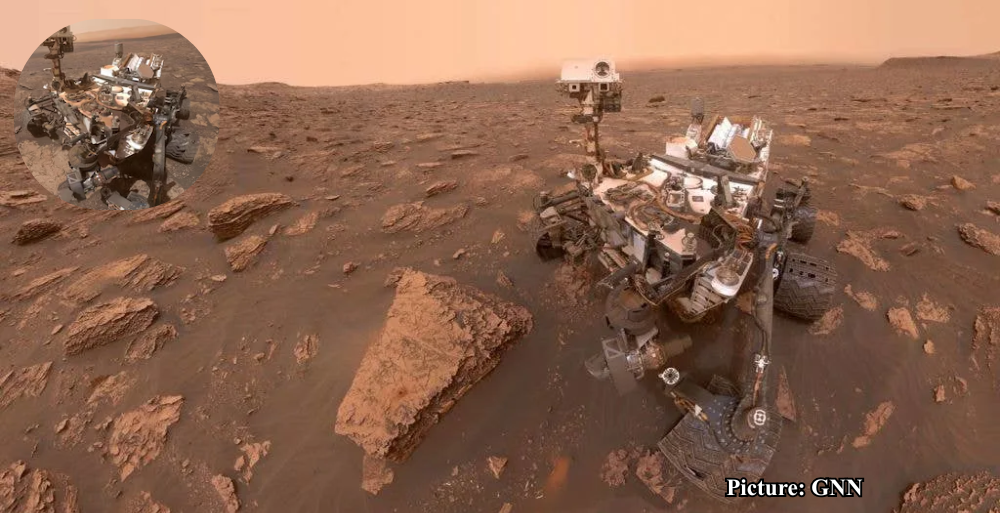
The Curiosity rover has identified a wide range of organic molecules on Mars, including seven previously undetected compounds, suggesting the planet may have been habitable billions of years ago.
The Curiosity rover, part of NASA’s Mars Science Laboratory, has made significant strides in the exploration of the Martian surface, recently uncovering the most diverse array of organic molecules ever detected on the planet. This discovery includes seven new types of carbon-containing compounds that have not been previously identified on Mars. The findings were published on Tuesday in the journal Nature Communications, marking a pivotal advancement in our understanding of the planet’s geological and potentially biological history.
These organic molecules, the building blocks of life on Earth, were found through a groundbreaking experiment in which Curiosity collected a rock sample and dissolved it in a chemical solution. This method is the first of its kind conducted on Mars, allowing researchers to unlock the secrets of the planet’s composition in unprecedented detail.
Dr. Amy Williams, the lead author of the study and an associate professor of geological sciences at the University of Florida, noted that the organic molecules identified are believed to have been preserved on Mars for approximately 3.5 billion years. “These findings are important because they confirm that larger complex organic matter is preserved on Mars over geologic time periods, despite the harsh radiation environment,” Williams stated. This preservation supports the ongoing search for habitable environments on Mars, defined as places where life could have existed if it were present.
Historical Context and Implications
The results align with previous detections of organic compounds by the Curiosity rover, reinforcing the hypothesis that Mars was once a habitable planet, contrasting sharply with its current barren, frozen landscape. Ashwin Vasavada, Curiosity’s project scientist at NASA’s Jet Propulsion Laboratory in Pasadena, California, remarked, “The revelation of the mission to me has been not just that Mars was habitable, but just how amazingly habitable it was.” This perspective underscores the potential for ancient life on Mars and adds to the growing body of evidence that the planet once supported conditions suitable for life.
While the wet chemistry experiment conducted by Curiosity was not explicitly designed to determine whether the detected organic molecules are indicative of ancient life or were delivered via meteorite impacts, it serves as a focal point for planetary scientists. The consensus among experts is that to definitively ascertain whether life ever existed on Mars, it is essential to return rock samples to Earth for detailed analysis.
Curiosity landed in Gale Crater in 2012 with the primary mission of assessing whether Mars could have supported microbial life. The rover has spent years climbing Mount Sharp within the crater, where it aimed to investigate clay-rich layers identified by orbiters. These clay layers are significant as they suggest the historical presence of water on Mars, which has since fluctuated over time.
After several years of exploration, Curiosity successfully reached the clay-rich area known as Glen Torridon in 2020. This region provided evidence of ancient lakes and sedimentary environments that were once conducive to life. The rover’s team, consisting of a diverse group of scientists, meticulously selected a drilling site named Mary Anning, in honor of the 19th-century British paleontologist, to collect a sample for organic material testing.
Methodology and Findings
Curiosity drilled into a sandstone sample containing clay minerals and analyzed it using the Sample Analysis at Mars (SAM) instrument. SAM employs a small oven to heat samples and detect gases released by minerals as they decompose. The rover utilized a solution of tetramethylammonium hydroxide (TMAH) to break down complex molecules and reveal previously invisible organic compounds.
Through this innovative approach, the research team identified 21 carbon-containing molecules, including a newly discovered nitrogen heterocycle. This structure, which includes nitrogen within a ring of carbon atoms, serves as a precursor to RNA and DNA, the molecules that encode genetic information in living organisms. Williams emphasized the significance of this finding, noting that nitrogen heterocycles had never been confirmed on the Martian surface or in Martian meteorites before.
Additionally, the analysis indicated the presence of benzothiophene, a molecule commonly found in meteorites, suggesting a shared history between Mars and Earth. Williams explained, “The same stuff that rained down on Mars from meteorites is what rained down on Earth, and it probably provided the building blocks for life as we know it on our planet.” This connection highlights the potential for similar organic chemistry across the solar system.
Future Prospects
The research team corroborated Curiosity’s findings through extensive laboratory tests on Earth, exposing a piece of the Murchison meteorite—known for its organic compounds—to TMAH. The tests revealed that the larger molecules within the meteorite broke down into similar compounds found in the samples from Mars, including benzothiophene. This comparison bolsters the credibility of Curiosity’s discoveries.
Curiosity’s recent achievements, including the detection of the largest organic molecules on Mars, coupled with observations from the Perseverance rover, are crafting a more comprehensive picture of Mars’s ancient environment. Vasavada stated, “I’m not an organic chemist myself, but seeing a diversity of organics means that you’re sensing kind of the tip of the iceberg of a greater diversity that was there in the past.” This growing understanding of Martian geology and chemistry sets the stage for future missions aimed at exploring life beyond Earth.
The European Space Agency’s ExoMars Rosalind Franklin rover, set to land on the red planet by the end of the decade, and NASA’s Dragonfly mission to Titan, Saturn’s moon, will incorporate similar wet chemistry experiments. Charles Malespin, principal investigator for SAM at NASA’s Goddard Space Flight Center, remarked on the importance of these developments, stating, “It was a feat just figuring out how to conduct this kind of chemistry for the first time on Mars. But now that we’ve had some practice, we’re prepared to run similar experiments on future missions.”
Dr. Briony Horgan, a professor of Earth, atmospheric, and planetary sciences at Purdue University, emphasized the significance of these findings in preserving evidence of organic material on Mars. While the exact origins of these organics remain to be clarified, she noted, “we’re starting to build up the data to answer that question.” To fully resolve the question of whether these compounds indicate life on ancient Mars, the return of samples to Earth remains a top priority for the planetary science community.
Despite a recent decision by Congress to cancel an ambitious plan to return samples collected by the Perseverance rover, many experts advocate for the necessity of this step in answering one of humanity’s most profound questions: Has life ever existed beyond Earth? Vasavada stated, “This program that started in 2000 ended with a definitive experiment to figure out if life ever existed. I want the story to finish.”






No Comment! Be the first one.