





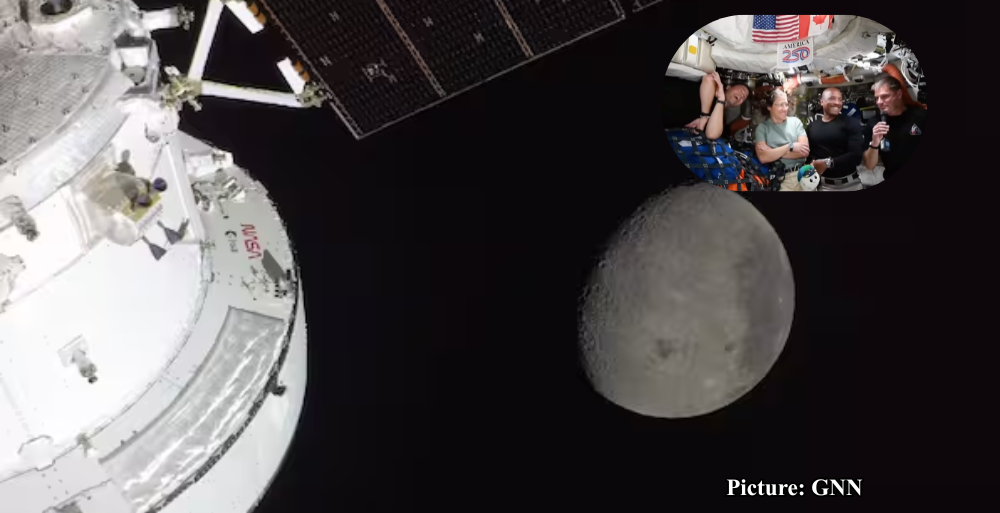
The Artemis II crew is poised for a historic return to Earth, navigating the challenges of a hypersonic re-entry that will test the limits of their spacecraft and technology.
The Artemis II mission, a significant milestone in human space exploration, is nearing its conclusion as four astronauts prepare to return to Earth after reaching a record distance of 406,771 kilometers from the planet. This ambitious journey, which began on April 3, 2024, will culminate in a high-speed re-entry into Earth’s atmosphere on April 10, 2024, at approximately 8 PM local time, landing in the Pacific Ocean off the coast of California.
Journey Back and Re-Entry Challenges
The Orion capsule, carrying the Artemis II crew, will re-enter the atmosphere at an astonishing velocity of over 11 kilometers per second (approximately 40,000 kilometers per hour). This speed is roughly 40 times faster than a commercial passenger jet, presenting unique challenges for the astronauts and the spacecraft. The kinetic energy of the spacecraft upon re-entry will be approximately 2,000 times greater per kilogram than that experienced by a jet, necessitating a complex and controlled re-entry process to ensure the safety of the astronauts aboard.
Spacecraft re-entry involves a delicate balance of aerodynamics and thermal protection. Unlike traditional aircraft, which are designed to minimize drag for fuel efficiency, the Orion capsule is engineered to maximize drag to decelerate effectively. This controlled re-entry not only slows the spacecraft but also helps manage the extreme forces at play, particularly the g-forces experienced by the crew.
During the re-entry, the astronauts will encounter significant acceleration forces, measured in g-forces. For context, a Formula One driver experiences about 5 g’s during sharp turns, approaching the limits of human tolerance. NASA’s Orion capsule is specifically designed to manage these forces, ensuring that the g-forces remain within survivable limits for the crew. The planned re-entry will last several minutes, allowing for a gradual deceleration that helps protect the astronauts from the physical stresses of rapid acceleration.
The Heat of Re-Entry
The re-entry of the Orion capsule will generate temperatures exceeding 10,000 degrees Celsius, nearly double the temperature of the Sun’s surface. This extreme heat creates a shock wave around the spacecraft, resulting in the formation of electrically charged plasma that temporarily disrupts radio communication with mission control. As a result, the crew will be unable to communicate during the most intense moments of their descent, a situation that has been anticipated and planned for by mission engineers.
To survive this harsh re-entry environment, the Orion spacecraft is outfitted with a sophisticated thermal protection system. This system acts as an insulative barrier, shielding the capsule and its occupants from the intense thermal and aerodynamic forces encountered during re-entry. The design incorporates advanced materials that are specifically tailored to withstand anticipated heat levels, with particular attention given to areas expected to experience the highest temperatures.
Ablative Heat Shields
The thermal protection system relies on ablative materials, which are designed to absorb heat and dissipate energy through controlled degradation. The heat shield of the Orion capsule is constructed from a material known as AVCOAT, a composite similar to that used in the Apollo missions of the late 1960s and early 1970s. Following the uncrewed Artemis I mission, engineers identified that the heat shield had undergone greater ablation than expected during re-entry, resulting in the loss of material in certain areas.
Despite these findings, NASA has opted to use the same type of heat shield for the Artemis II mission, albeit with modifications made to the re-entry trajectory. Engineers have adjusted the planned flight path to minimize pressure buildup within the heat shield material, which had contributed to the unexpected ablation in the previous mission. These careful recalibrations aim to enhance the safety and integrity of the spacecraft during its return journey, reflecting NASA’s commitment to learning from past missions to improve future outcomes.
Looking Ahead
The Artemis II mission represents a pivotal step in NASA’s ongoing efforts to return humans to the Moon and eventually journey to Mars. As the crew prepares for their re-entry, excitement and anticipation build among both the public and the aerospace community. The successful completion of this mission will not only showcase the resilience of human ingenuity but will also lay the groundwork for future exploratory endeavors in deep space.
With the mission nearing its end, many eagerly await the moment when the Artemis II crew is welcomed back safely to Earth. Their journey, marked by unprecedented achievements and challenges, highlights the enduring spirit of exploration that drives humanity to reach for the stars. The Artemis II mission is not just a test of technology; it is a testament to human collaboration and determination in the face of formidable challenges.
As NASA continues to advance its lunar exploration plans, the lessons learned from Artemis II will inform future missions, including the upcoming Artemis III mission, which aims to land astronauts on the Moon’s South Pole. This ambitious goal underscores the importance of ongoing research and development in space technology, as well as the need for robust safety measures to protect astronauts during their journeys into the unknown.
In conclusion, the Artemis II mission serves as a remarkable example of what can be achieved when science, technology, and human courage converge. As the world watches the crew’s return, it is a moment of reflection on the progress made in space exploration and the challenges that lie ahead in humanity’s quest to explore the final frontier.





No Comment! Be the first one.